Duas coisas são infinitas: o universo e a estupidez humana. Mas, em relação ao universo, ainda não tenho a certeza absoluta.
(Einstein)
But the tune ends too soon for us all (Ian Anderson)
Researchers from Imperial College London this week released an analysis of the health of voters in the UK. In a publication associated with British Medical Journal, the experts claimed to have found that people who vote for Reform are disproportionately sick.
I am sure that the researchers in question could not possibly have enjoyed coming to their conclusions. But they reported that the conditions Reform voters are most likely to suffer from include obesity, chronic obstructive pulmonary disease and epilepsy.
The scientists did not go so far as to claim that voting Reform makes you epileptic. As every smart-aleck first-year at Imperial could tell you, correlation does not imply causation. But they did claim to have found that those in Reform-voting areas were unusually likely to suffer from the aforementioned conditions plus arthritis, dementia, depression and learning disabilities.
The researchers justified their findings by pointing out that it’s poorer and older parts of the country which are more likely to vote Reform. But I cannot help thinking that they have missed a number of other fruitful areas of research. Perhaps I can suggest a few?
For instance, there are certain places, particularly in the north of England, where a disproportionately high number of people have been born with severe genetic disorders and other birth defects.Frequently these are the result of a marriage between first or second cousins. This would seem to me to be a very interesting area to study.
Surely after digging into the possible causes of these medical problems the researchers could go on to confirm whether or not areas with a high number of birth defects also have a disproportionate number of Labour voters? People might wonder what the value of such research would be. But perhaps it could assist couples considering entering into a consanguineous marriage if they knew that as well as doubling their risk of producing a child with a rare genetic disorder they are also, no doubt, doubling their likelihood of voting Labour, and likely tripling their chances of voting for whatever Jeremy Corbyn’s new party is called.
I suppose such a study might cause more controversy than the research just published. After all, the easiest group in society to pathologise are older white voters – especially if they are poor. These people can already be called ‘racist scum’ and ‘gammons’. So it is no special leap to suggest this demographic is also epileptic and demented.
Still, if we are in the season of diagnosing people based on their political beliefs, perhaps I could throw a few diagnoses of my own out there. It has long seemed to me that we should attempt to diagnose the sort of condition that leads people to head out on to the streets in fancy dress week after week to scream and holler at their fellow citizens.
Last Saturday there was an especially interesting specimen on one of the ‘Free Palestine’ marches in London. A bespectacled, blond, gangly student in a keffiyeh and a bomber jacket bounced about with a microphone in front of a crowd. He informed the gathering that they should be inspired by the ‘steadfast and noble resistance in Palestine and in Gaza’. He then offered them a chant that ‘we’ve been workshopping in Oxford’. ‘Maybe you guys want to join in,’ he suggested as he bounced around. The chant (offered on the day the ceasefire in the Middle East began) was ‘Gaza, Gaza make us proud, put the Zios in the ground’.
The youth in question turned out to be one Samuel Williams, originally from Tunbridge Wells. His reference to workshopping his chant in Oxford (something street mobs always look for in their chants) turns out to originate from the fact that Williams is currently studying PPE at Balliol College.
It is not for me to give a full diagnosis of a patient I have only studied in a video, but it does seem to me that this young Oxonian’s performance lends credence to my general analysis of his type. Which is that Master Williams and his ilk are disproportionately likely to suffer from feelings of grandiosity, narcissistic personality disorder, gender dysphoria and bouts of St Vitus’s dance.
In fact, street protest movements in general throw up a fascinating range of pathologies that deserve far more rigorous study. For example, in the United States there are intermittent protests against Republican policies on abortion. For some reason the women (they are almost always women) who attend these protests like dressing as characters from The Handmaid’s Tale – never the lower-status women from Margaret Atwood’s novel, only ever the red-tunic-ed ones from the classier end of the dystopian social spectrum. In their nun-like habits, these women chant endlessly about how conservative lawmakers should keep out of their vaginas. I use this language only because the women do so themselves. Yet to date there is little evidence that Republican lawmakers want to go anywhere near these protestors’ vaginas.
Nonetheless, these women parade around Washington D.C., congregate around burly police and army men and pretend laws which are meant to protect the unborn child are in fact intended so that high-status, right-wing men will be allowed to tie these women down and impregnate them against their will. Is it too much to suggest the protestors are suffering several co-morbidities? Such as a deranging level of sexual frustration? I wonder.
Finally, what are we to say of the green activists who have decided that the best way to save the planet is to ejaculate tins of paint on to priceless canvases? Or to parade around our cities with chalk-white face-paint while dressed (once again) in clerical robes? What are we to make of these people who spent years engaging in cult-style worship of an autistic child-goddess?
Some people will react to Imperial’s Reform research with calls to shut it down. Personally I should like a lot more such research. My only request is that the scientists cast their areas of interest wider, and develop a strong backbone for the criticisms that will doubtless next time come their way.
Numa entrevista a Ventura, quem está a ser entrevistado não é Ventura, mas os próprios entrevistadores. É, para os entrevistadores, uma espécie de entrevista de emprego.
Porque é que, quando têm de entrevistar o líder do Chega, os jornalistas e comentadores ficam de repente estúpidos? A cena repete-se há anos. Ninguém parece querer ou ser capaz de fazer perguntas a André Ventura. Estão ali para o contradizer, para o desmentir, para lhe chamar nomes. Não são nem nunca foram assim com nenhum outro entrevistado. Álvaro Cunhal, que em 1975 tentou fazer abortar a democracia em Portugal, foi sempre entrevistado com urbanidade, apesar das suas incontornáveis “cassetes”.
Obtêm os entrevistadores, com os seus impropérios, alguma coisa de André Ventura? Não. É talvez o lado mais absurdo de tudo isto. De entrevista em entrevista, todos já deviam ter aprendido que Ventura não se deixa intimidar por más maneiras, e que vai preparado para armadilhas. Também seria de esperar que soubessem outra coisa: que os ataques do entrevistador dão uma enorme vantagem a Ventura. Outros entrevistados têm de responder a perguntas, ou correr o risco de parecer que não respondem; Ventura só tem de rebater e retribuir agressões e pedradas.
Os jornalistas e os comentadores não percebem isto? As pessoas, não sendo estúpidas, só se comportam como se o fossem por duas razões: ou quando não compreendem a situação, ou quando, compreendendo, o medo – a pior das emoções — as paralisa ao ponto de não conseguirem agir de modo inteligente. O segredo da entrevista a André Ventura parece-me que está aqui: diante de Ventura, o jornalista e o comentador são gente assustada. Mas não é Ventura que lhes mete medo. São os outros: todos os que o entrevistador imagina que o estejam a ver, ouvir ou ler a entrevistar André Ventura. É a pressão dessa multidão imaginária que torna estúpido o entrevistador.
O cerco que a esquerda e parte da direita montaram a André Ventura não dissuadiu 1,5 milhões de portugueses de fazerem do Chega, em seis anos, o segundo maior partido parlamentar. Não se deixaram intimidar. Mas aqueles que lutam por empregos, posições e destaque no sistema mediático, esses, sim, ficaram apavorados. A tese de que não se deve “dar plataforma” ao Chega ou de que o Chega não pode ser “normalizado” tornou a entrevista a André Ventura no exercício mais perigoso do jornalismo em Portugal. Diante de Ventura, o entrevistador sabe que toda a gente o está a vigiar. Vai ele deixar Ventura falar? Vai ele tratá-lo como a qualquer outro entrevistado? Ai dele: estará a incorrer no crime de lhe “dar plataforma” e de o “normalizar”. Por isso, a preocupação principal do entrevistador, perante Ventura, não é levá-lo a responder a perguntas, mas distanciar-se dele, mostrar que nada tem a ver com ele, pelo recurso primitivo de o afrontar e insultar.
Há, no jornalismo, activistas anti-Chega. Mas mesmo a manifestação do preconceito, de tão ostensiva, precisa de ser explicada, porque é regra, em relação a tudo o mais e por uma questão de profissionalismo, o jornalista tentar passar por imparcial. Só em frente de Ventura o fanático julga que pode ou até deve expor o seu fanatismo. Até o mais encartado activista se sente obrigado a exibir excesso de zelo. Não está menos assustado.
Numa entrevista a Ventura, é como se quem estivesse a ser entrevistado não fosse Ventura, mas o entrevistador. Funciona, para os entrevistadores, como uma espécie de entrevista de emprego. É a ocasião de provarem que nada têm a ver com Ventura e, por isso, merecem a consideração e as posições que têm ou a que aspiram. Tal como quando classificam os debates de Ventura, não estão a pensar no líder do Chega, mas nos colegas e correligionários que os possam acusar de simpatia pelo diabo ou de pouca fé, e fazê-los “cancelar”. Não lhes interessa a verdade, mas apenas serem aceites.
O problema não se esgota na BBC, no fundo um (grande) rolamento numa monumental traquitana de falcatruas. O problema é os “media” terem decidido que lhes compete educar as massas.
Sabiam que, em 2014, a BBC relatou as violações de Rotherham chamando aos muçulmanos paquistaneses que as perpetraram “gangues asiáticos”? Sabiam que, em 2024, a BBC revelou uma discriminação racial no preço do seguro dos carros que afinal não existia? Sabiam que, em 2008, a BBC censurou uma ligeiríssima alusão a Maomé (e à montanha) na série “Blackadder” enquanto permitia abundantes piadas alusivas ao cristianismo? Sabiam que, em 2025, a BBC transmitiu um documentário sobre Gaza em que o narrador era filho de um dirigente do Hamas? Sabiam que, de 2023 a 2025, a BBC evitou reportagens que pudessem beliscar o movimento “trans”? Sabiam que, em 2012, a BBC acusou um “lord” conservador de abusar sexualmente de crianças em “contexto de racismo” e em que o desgraçado era completamente inocente? Sabiam que, em 2014, a BBC eliminou do programa “Free Speech” (ai, a ironia pesada) a questão “Será possível ser muçulmano e gay?” Sabiam que, em 2020 e 2021, a BBC calou, distorceu, exagerou e, sim, mentiu em tudo o que pôde de modo a alimentar a cantilena oficial em volta da Covid? Sabiam que, em 2012, a BBC produziu uma história acerca do “racismo estrutural” no futebol europeu através de manipulação de dados com “racistas” interpretados por figurantes? Sabiam que, em Julho de 2024 e em Novembro de 2025, a BBC repreendeu formalmente duas “pivots” que exibiram desdém pela expressão “pessoas que engravidam”? Sabiam que, em 2021, a BBC cobriu o assalto anti-semita a um autocarro em Londres e apresentou como “atenuante” (?) o pormenor de o áudio do incidente incluir “insultos anti-muçulmanos”, de facto o som de uma criança judia a gritar por socorro em hebraico? Sabiam que, em 2022 e com repetição em 2024, a BBC mutilou severamente um discurso de Donald Trump para dar a entender que ele apelara à invasão do Capitólio?
Desta última manigância vocês sabiam. E sabem quem sabia de todas, estas e outras, desde sempre, embora fingissem o contrário? As cúpulas e as tutelas da BBC. O estratagema é similar vai para 20 anos, pelo menos. A BBC falsifica notícias, inventa “casos”, difunde patranhas convenientes às “causas” que serve, suprime informação comprometedora para essas “causas” e, em suma, esforça-se por aldrabar tanto quanto possível os espectadores que, por ingenuidade ou perversão, ainda consomem semelhante miséria.
Se uma determinada aldrabice suscita excessivo escândalo, a BBC invariavelmente adopta o código de honra do larápio que só se arrepende quando o roubo é descoberto. Primeiro, lança um pedido de desculpas mais esfarrapado que as bandeiras portuguesas após o Euro 2004. De seguida, demite ou aceita a demissão de um director ou dois e troca-os por criaturas igualmente devotas ao viés em voga e empenhadas em perpetuar a fraude, uma fraude que anualmente custa seis mil milhões, e que, de tão preocupada em não ofender “sensibilidades”, ofende brutalmente o bom senso.
Sucede que, por incúria do Todo Poderoso, o bom senso não é distribuído com equidade – o bom senso e a vergonha na cara. Mesmo confrontada com a infantil truncagem do discurso de Trump, houve muita gente a relativizar o episódio, que em última instância não teria passado de um erro jornalístico ou, vá lá, de um exemplo reprovável e inconsequente de mau jornalismo. Até eu, que levo a sério o Efeito Borboleta, acho extraordinário acreditar-se que colar frases soltas e escolhidas à medida do que se pretendia dizer que Trump disse é um “erro”, no sentido de lapso. E acho abusivo que se fale em “mau jornalismo”. O que a BBC tem andado a fazer, com Trump, Gaza, o “racismo”, o Islão, o “transgenderismo” e o que lhe apetece, não é nada que se pareça com jornalismo, bom, sofrível, mau ou péssimo. Aquilo é propaganda, o exacto tipo de propaganda que se espera das televisões da Venezuela, de Cuba e da Rússia. E que já ninguém se espanta por encontrar nas televisões do Reino Unido e do Ocidente em geral.
Claro que hoje o problema não se esgota na BBC, no fundo um (grande) rolamento numa monumental traquitana de falcatruas. O problema também não se prende com o engajamento ideológico dos “media”, que era comum com maior ou menor franqueza à direita e à esquerda e ao centro. O problema é os “media”, quase todos os “media”, terem decidido que lhes compete educar as massas, e educá-las num sentido bastante específico, invariavelmente subjugado às directivas dos governos que, com raras e odiadas excepções, mandam na Europa e arredores. É possível discutir quem manda nos governos. É impossível negar que, por fragilidade, anacronismo e ideologia, o “quarto poder” aliou-se aos restantes e, em vez de escrutínio, desatou a promover a bajulice. Uma considerável parte dos jornalistas actuais não são jornalistas, mas cortesãos.
E se os “jornalistas” defendem a corte, é natural que a corte ampare os “jornalistas”. Em ambas as esferas, já demasiado misturadas, adoptou-se esta semana a cartilha habitual com o habitual descaramento: a BBC e o jornalismo e a democracia e quiçá o sistema solar estão sob ataque cerrado de “radicais”, fatalmente de “extrema-direita”. Por sorte, temos os moderados para nos proteger – da “desinformação” e do resto.
Growing up, like a lot of English girls, I was what was known as a ‘dirty blonde’. (An evocative phrase, the Dirty Blondes are now variously a theatre troupe, a pop group and a restaurant.) In the summer, I would put lemon juice on my hair and watch in wonder as it bleached in the sun; I mainly did it to irritate my mother, who found overly blonde hair ‘tarty’. When I grew my impressive rack and shot up to 5ft 8in at 13, what I thought of as ‘The Bothering’ started – grown men attempting quite openly to pick me up, especially when I was wearing my school uniform. Blonde hair was the last thing I needed.
Like many a dreamy teenager of the time – I’m not sure it still happens – I was drawn to the mythical beings of Hollywood. I remember a poster I owned, jostling with pin-ups of the very contemporary David Bowie and Bryan Ferry (both themselves Hollywood obsessives), which was a drawing of James Dean and Marilyn Monroe bearing the legend WHERE HAVE ALL THE GOOD TIMES GONE? This could be seen as somewhat insensitive in our touchier times, considering that they’d both been unhappy people who died young.
But though I adored Marilyn – as one would adore a wounded animal crossed with a goddess – it was the swashbuckling brunettes of Hollywood I saw as role models: the Liz Taylors and Ava Gardners. I was probably one of the few teenage girls ever to watch Gentlemen Prefer Blondes and want to be the Jane Russell character, with her tough good humour and straightforward lust. When I got the news that I’d bagged my first job in journalism and could scarper from the family home, I dyed my mousy hair jet black and never looked back.
I’ve identified as a brunette all my life, and when my roots started coming through white a decade ago, in my fifties, there was no question that I’d be trooping off every three weeks to the hairdresser to have them covered up, and damn the expense. I viewed women in the public eye who let their grey/white hair grow out with something approaching moral panic; from Angela Carter to Mary Beard, I saw them – ludicrously – as in some way negligent of their personal care. I had no such feelings about famous men going grey, though I’ve never bought the ‘Silver Fox’ nonsense. To be fair, I viewed my own reflection with its three inches of pure white roots with a similar horror during lockdown, and when the hairdressers were allowed to open, I was straight round there.
Which makes my current attitude to having increasingly grey – white, really – hair all the more surprising. I haven’t had my hair dyed since November 2024; after emergency spinal surgery in December I spent five months in hospital, emerging a cripple, in a wheelchair. I’ve lost my legs, my front teeth, my splendid rack – and my lovely thick, glossy, tossable brunette mane. Due to medication and stress (I always swore I’d never use that word, but I reckon it’s allowable when you lose the ability to walk) my hair is much diminished in every way, wig-fulls coming out with every brush-stroke. It’s real sparse, scalp-showing old-lady hair of the kind I arrogantly believed I’d never have.
I’m aware that it would be easy to correct – there are lots of home-visiting hairdressers, especially in my senior-friendly ’hood of Hove. But I appear to have had something of a satori. Doing everything in my power to appear youthful and robust, once highly important to me, now seems rather silly and self-defeating. I’m a disabled 65-year-old, soon to be an actual OAP; what’s the point in pretending to be anything else?
Last summer a cross ex-friend wrote me an angry message about this very issue, apparently perturbed by my upbeat, Pollyanna-ish nature and my pleasure-seeking sociability. Knowing her as well as I did, I knew that much of the impetus came from her fathomless dissatisfaction with her own life, but I wonder if there wasn’t something in it when she accused me of ‘making a fool of yourself prancing around like a teenager when you’re almost a pensioner’. Perhaps she had a point; maybe it wouldn’t kill me to be more age-appropriate? Indeed, if I hadn’t been intent on acting like someone much younger and tougher, I’d have gone to the doctor when my health problem started rather than leave it till it was too late.
Letting my hair grow out white could be the way I force myself to accept that my gallivanting days are over. It helps that in the bed opposite me at the rehabilitation unit was Sue, a gorgeous woman of a certain age with pure white hair and a look of Helen Mirren. But I know myself – and my hair – well enough to comprehend that if I carry on down the au naturel route, I won’t be a Sue – I’ll be a Struwwelpeter.
Is letting one’s hair grow out as Nature intended a white flag or a gesture of defiance? I veer between the two schools of thought. The publication of Victoria Smith’s excellent book Hags: The Demonisation of Middle-Aged Women in 2023 clarified thoughts which had occurred to me since I passed the first flush of youth, and which became amplified during the height of the trans debate, when my side had the word ‘old’ flung at it as though it was a word on a par with child-killer. Reviewing the book in the Guardian, Rachel Cooke wrote:
The surprise is that I find myself on the receiving end of as much sexism and misogyny now as I did when my bum was pert and my breasts very bouncy – and nearly all of it comes from those far younger than me. Was the harassment I experienced when I was young better or worse than the dismissive contempt that’s aimed at me today? I’m not sure.
Why are so many men angry at women, past the first flush of youth, who let themselves go? I think it may have something to do with the drastically different levels of sex available to heterosexual men and heterosexual women. Women find sex very easy to come by; by the time a woman reaches the menopause, she will have had all the sex she wanted – and perhaps quite a lot she didn’t. Unless a man is very good-looking, or rich, or famous, the same certainly won’t be true of him, unless he has a very low sex drive. Giving up seeking male attention is an acknowledgement of this; letting one’s hair whiten the most obvious aspect. Whatever the reason, the rude invitations from strangers in the street that started when I was 13 and lasted until I was into my sixties are well and truly over; now men smile pityingly at me as they hold the door for my husband to push me through in my wheelchair. I wouldn’t have chosen to be a balding, white-haired ‘halfling’ – but I’m damn well going to make the best of it. And only in a slightly age-inappropriate way, I hope.
Last Sunday the Vatican released the first photograph of Pope Francis since his ordeal began. He was wearing a stole around his neck, indicating that he had concelebrated mass in the chapel of the Gemelli hospital. Admittedly, all he had to do was raise his hand and whisper a few words of consecration, but it would have been impossible to take such a photo a week earlier, when Vatican-watchers were checking their phones hourly to discover whether the See of Peter had become vacant.
Francis is still very ill, of course, and everyone noticed that the picture was taken from behind, perhaps to hide his oxygen tube. The image was touching but unintentionally symbolic. For the first time during this pontificate, power-hungry curial officials are flexing their muscles behind the back of a severely weakened pope.
One cardinal in particular is pushing his luck: Pietro Parolin, the Secretary of State, who is both the Vatican’s prime minister and foreign minister. The 70-year-old Italian career diplomat, known for his silky charm, has spent years weaving alliances with rival factions in the Church. Given Francis’s habit of defenestrating top advisers without warning, it’s testimony to Parolin’s political skills that he has held on to his job for 12 years. But it is one thing to cultivate useful friends; it’s quite another to exploit the pontiff’s absence to behave like a deputy pope, which the Secretary of State emphatically is not. And it’s most dangerous of all to behave like a pope-in-waiting. Yet that is what Cardinal Parolin is doing.
On 24 February, when it looked as though Francis was close to death, he presided over the first prayer vigil in St Peter’s Square. The tearful crowds assumed that Parolin, the most powerful cardinal in the Church, was the natural choice to lead it. But precedence in the Vatican is a complicated business. Parolin is outranked by Cardinal Giovanni Battista Re, who as Dean of the College of Cardinals is responsible for summoning a conclave when a pope dies and preaches the funeral homily. Re is 91 and was due to step down last month. Parolin was preparing to succeed him when Francis renewed Re’s tenure indefinitely. In other words, the Pope blocked his Secretary of State from also becoming Dean. It was a brutal snub. Nevertheless, it was Parolin, not Re, who led the tearful crowds in the rosary, causing some colleagues to mutter about sharp elbows.
Eyebrows were raised again on 14 March, when Ukrainian President Volodymyr Zelensky thanked the Vatican for its support in facilitating the return of children deported by Russia. He did so in a phone conversation with Cardinal Parolin rather than with the Pope’s personal emissary to Ukraine, Cardinal Matteo Zuppi of Bologna, who helped negotiate the prisoner exchange. Friends of Zuppi – who is widely seen as Parolin’s rival among the Italian bishops – felt that the Secretary of State was exceeding his brief.
Now we learn that Parolin will preside over the mass in St Peter’s on 2 April marking the 20th anniversary of ‘the return to the House of the Father’ by St John Paul II. This, too, has put noses out of joint. John Paul’s signature achievement was his role in the collapse of Soviet communism, made possible by ditching the Church’s naive policy of Ostpolitik. Cardinal Parolin, by contrast, resurrected it when he negotiated the 2018 pact with Beijing that has ceded control over the appointment of Chinese Catholic bishops to the Chinese Communist party (CCP) – a deal that could have been agreed only over John Paul’s dead body.
‘These instances of Parolin stealing the limelight may be unremarkable in themselves, but together they demonstrate that he’s the only papabile cardinal who is actually running as a candidate,’ says a Vatican observer. ‘And this won’t have passed unnoticed by the Holy Father, whose apparent recovery was perhaps not anticipated by Parolin.’
The source points out that when the Secretary of State was summoned to the Pope’s hospital bedside on 2 March he was accompanied by his Venezuelan deputy, Archbishop Edgar Peña Parra, who acts as papal chief of staff. ‘Parolin doesn’t get on with Peña Parra, whom the Pope prefers to him. Coming right after Francis blocked Parolin as Dean, inviting his deputy was another snub.’
If Parolin can’t conceal his Machiavellian ambitions, why is he portrayed in the media as an unassuming ‘moderate’ whose supporters among the 137 cardinal electors include liberals and conservatives? There is nothing moderate about the surrender to Beijing. And Parolin’s attitude towards the traditional Latin Mass – increasingly popular with young Catholics – can hardly be described as tolerant. He was one of the Italian bishops who pressed Pope Francis to ban the ancient liturgy.
In contrast, the Secretary of State has picked his way through the minefields of women’s ordination and gay blessings, the two issues that could cost him Asian and African votes. His public line is that the ban on ordained female deacons is ‘non-negotiable’, but the late Cardinal George Pell recalled that he once tried to persuade him to support the idea. In some ways Parolin resembles Francis (then Cardinal Bergoglio) before the 2013 conclave – a closet liberal who tells conservatives what they want to hear. ‘He doesn’t give you the impression that he hates the Church,’ concedes one of Parolin’s enemies.
A Pope Parolin would sideline the experiment in ‘synodality’ – an Anglican-style talking shop for woke activists – that is trying the patience of bishops the world over. He would continue to embed liberals in the Roman curia, but would steer clear of the pro-abortion zealots and trans-rights fanatics whom Francis hosted in order to goad the traditionalists.
The biggest danger is that Parolin’s Chinese allies would increase their grip on Vatican City, whose computers they have already hacked: just last week Meng Anming, a Chinese biologist and CCP loyalist, was appointed to the Pontifical Academy of Sciences. Catholic campaigners for human rights in China also suspect that Beijing, which owned the gay hookup app Grindr when it was installed on hundreds of clerical smartphones, has vast amounts of Kompromat to play with – a factor, perhaps, in the Vatican’s kowtowing to the CCP.
The Beijing pact is the Secretary of State’s Achilles’ heel. In 2018 Cardinal Joseph Zen, the heroic 93-year-old former bishop of Hong Kong, accused Parolin of having ‘a poisoned mind. He is very sweet, but I have no trust in this person’. In 2020 he went further, describing his defence of the deal as sickening. ‘Parolin knows he himself is lying,’ said Zen. The Pope was being manipulated by ‘the Most Eminent Parolin and his henchmen’. For a prominent cardinal to attack a Secretary of State using such language was unprecedented. Yet it made few headlines in the secular press.
This brings us to a crucial weapon in Cardinal Parolin’s armoury: his cosy relationship with the Vatican left-leaning press corps, which has concealed Francis’s protection of Latin American sex-abusers as doggedly as White House correspondents tried to hide Joe Biden’s mental decline. For more than a decade Parolin has supplied journalists with exclusives in return for their discretion. Questions about disappeared Chinese bishops have not been asked; nor is there curiosity about Parolin’s relationship with the defrocked ex-cardinal Theodore McCarrick, who travelled to China to negotiate the notorious deal long after the Vatican knew he was a serial predator.
And what did Parolin know about Bishop Gustavo Zanchetta? This Francis protégé was jailed for four-and-a-half years for his assaults on Argentinian seminarians – but only after the Pope tried to airlift him to safety by employing him to oversee the Vatican treasury. In 2017 a horrifying account of Zanchetta’s crimes was given to Mgr Vincenzo Turturro, deputy nuncio in Buenos Aires. Turturro, formerly Parolin’s private secretary, passed on the details to the Secretary of State, who said nothing while Francis covered up for Zanchetta.
Cardinal Parolin’s scandalous failures, which include catastrophic financial losses incurred by his staff in a London property scandal, transcend the question of whether he is liberal or conservative. But, of course, it still matters: if his feline manoeuvres succeed – if he persuades the African cardinals that he is fundamentally orthodox – then he is better placed than any of the papabili to become pope.
There may well be a conclave this year: there is speculation that, if Francis does move back to the Casa Santa Marta, he will receive the equivalent of hospice care. One rumour has it that he will appoint a senior official, not necessarily a cardinal, to act as his deputy. Another report suggests that he will meddle with the conclave rules to stop orthodox cardinals comparing notes.
At the moment, the conservatives don’t appear to have a candidate. The scholarly Cardinal Peter Erdo of Esztergom-Budapest is nervous and hesitant; the ex-Protestant Cardinal Anders Arborelius of Stockholm is deeply spiritual, but it doesn’t help that he is a Carmelite – having experienced a Jesuit pope, cardinals are wary of electing another member of an order. The Italian Cardinal Fernando Filoni is a diplomat who risked his life as ambassador in Baghdad – but he’s been accused of keeping quiet about McCarrick. Cardinal Pierbattista Pizzaballa, Latin Patriarch of Jerusalem, made headlines when he offered himself as a hostage in place of Israeli children. He exudes a dignified charisma and doesn’t belong to any faction but is perhaps too young at 59.
As for the liberals, Francis loyalists are divided between the Portuguese Cardinal José Tolentino Mendonca, prefect of the Dicastery for Culture and Education and an admired poet, and the ‘bicycling beanpole’ Cardinal Zuppi, a kind-hearted socialist fond of the Latin Mass. Both men are gay-friendly, which will make it difficult to achieve the necessary two-thirds majority.
Then there is the exuberant Cardinal Luis Antonio Tagle from the Philippines, mysteriously demoted by Francis as head of evangelisation but now back in favour. Another liberal possibility, incredibly, is the jargon-spouting Cardinal Mario Grech, the Maltese secretary general of the Synod of Bishops. He’s despised by conservatives, who call him ‘the bozo from Gozo’.
But none of the above can boast a contacts book, knowledge of secrets or reserves of patronage to compare with those of Cardinal Parolin. On the other hand, none has been branded a poisonous liar by a cardinal regarded by many as a living saint. A great deal depends, therefore, on whether the former leader of the Catholic Church in Hong Kong can attend the pre-conclave meetings at which cardinals ineligible to vote advise the electors – assuming, of course, that the 93-year old cardinal outlives the 88-year-old pontiff. What we do know is that Zen wants to be there, and that it is in Parolin’s interests to stop him. Beijing is intensely interested in the outcome of the conclave. Will it intervene?
The monster known as the Antichrist has been stalking Christians for nearly 2,000 years. Mostly it has fed the nightmares of frightened peasants or credulous fundamentalists. But now it has emerged from the most secular place on Earth, Silicon Valley, and its prophet is a billionaire venture capitalist married to a man.
The origins of the Antichrist legend lie in the Book of Revelation, in which the nations submit to a Beast whose name is concealed by the number 666. He forces everyone to receive a mysterious ‘mark on their right hands or foreheads’ without which they cannot buy or sell anything. This triggers the return of Jesus at the Battle of Armageddon. Early Christians seized on the ambiguous term ‘antichrist’, a word found in the Epistles of John, used in the plural to refer to heretics in general, and combined it with the Beast. Enter the demonic supervillain known as the Antichrist – a Satanic demagogue so seductive that he conquers the world and, in more recent interpretations, uses his implanted mark to usher in one-world government.
Down the centuries, every generation of Christians has played the game of identifying a real-life enemy as the Antichrist. Its champions have included itinerant barefoot friars, witch-hunting Puritans and perma-tanned televangelists. The list of unmasked Antichrists is impressive: Mohammed, innumerable popes, Martin Luther, King George III, Adolf Hitler, Henry Kissinger and Bill Gates. The founder of Microsoft qualifies twice over: he introduced the computer software that will enable the Beast to terrorise the faithful, and then he circulated vaccines – a mark on the hand! – to manipulate their DNA.
Prophecies of the Antichrist have always had a paradoxical relationship with technology. They were spread by new means of transport and went viral after the inventions of printing, moving pictures and the internet. At the same time, every innovation created fresh possibilities for the End Times tyranny of Satan.
How bizarre, then, that today’s most influential proponent of the Antichrist thesis should be Peter Thiel, who at first glance is a poster boy for the sinister global elite. He ticks nearly every box. He’s a handsome, silver-tongued homosexual who qualified as a lawyer at Stanford University, became unimaginably rich as a trader and investor, belongs to the Bilderberg Group, fantasises about sea and space colonies, and flirts with a transhumanist ideology that seeks to abolish physical death. And how did Thiel become a billionaire? By co-founding PayPal. Remember what Revelation says about the Beast seizing control of buying and selling?
Yet, in reality, what Thiel actually represents is the surreal reconfiguration of politics in the 21st century. As he reclines in his Gulfstream jet en route from Los Angeles to his mansion in Hawaii, he dreams of the downfall of a globe-trotting liberal elite who he believes are using their billions to manufacture a new world order. He calls them ‘the Antichrist’. Like many American fundamentalists, he worries that dark forces are using supranational institutions such as the United Nations to control the world. He has become a citizen of New Zealand and has bought land there as insurance against nuclear Armageddon.
Thiel may be reviving a toxic conspiracy theory, but ‘the philosopher king of Silicon Valley’, as he’s been called, is a disciple of Carl Schmitt and René Girard and his prophecies are expensively tailored. In June, his vision of Antichrist was the subject of a chin-stroking discussion between Thiel and Ross Douthat on the latter’s New York Times podcast.
Thiel does not play the game of naming a contemporary figure as the Antichrist. Instead he separates the two components of the legend – supervillain and global tyranny. He doesn’t think that the nations will grovel before the Beast disguised as a charismatic saviour. But, as he told Douthat, he does think we are sliding towards ‘a one-world government to control all the computers, log every single keystroke, to make sure people don’t program a dangerous AI’.
The fear of a catastrophe generated by artificial intelligence is reasonable. In contrast, the prospect of one-world government is hardly more credible than the anxiety of Reagan-era fundamentalists that the Beast would use supermarket barcodes to enforce a new world order. In Thiel’s musings, the clever and the silly are inextricable. He makes the excellent point that China’s relative lack of progress in AI may prompt it to seize Taiwan ‘because they know it’s now or never’. But his perception of the arc of history is as full of holes as Hal Lindsey’s The Late Great Planet Earth. That book, the bestselling non-fiction title of the 1970s, argued that the Bible prophesied the Six-Day War, the rise of the Common Market, nuclear weapons and ‘a sophisticated computer system’ to run a cashless economy. (There is no mention of PayPal, since Thiel was only three years old when it was published.)
Thiel’s model of history celebrates the first moon landing as the last ‘accelerationist’ step towards a techno-utopia before risk-averse peaceniks plunged us into stagnation. He tells Douthat: ‘We landed on the moon in July of 1969, Woodstock started three weeks later and, with the benefit of hindsight, that’s when progress stopped and the hippies won.’ According to Thiel, the fantasies of those hippies then infused international bodies; they propagated a militant environmentalism, epitomised by his bête noire Greta Thunberg, that has become the only meaningful ideology in the West.
There’s some truth in this, but paradoxically Thiel underplays the role of Silicon Valley technology in undermining progressive orthodoxies, to the point where liberal agents of what he calls the Antichrist are resorting to attacks on free speech, especially in universities, that provoke a further backlash.
The consensus around net zero is crumbling fast; the scowling, self-important Greta is a laughing stock. Meanwhile, on the world stage formerly sacrosanct global bodies have lost credibility; in an interview published last week Pope Leo XIV said that the United Nations ‘has lost its ability to bring people together on multilateral issues’. Fewer people trust the World Health Organisation, now deeply infiltrated by the Chinese government responsible for the outbreak of Covid-19.
During the pandemic, nation states retreated into themselves; when they emerged they were notably less internationalist. The debate about Britain rejoining the European Union has fizzled out as pro-EU politicians realise, even if they won’t admit, that it can’t survive in its present form. Meanwhile, the deaths of perhaps 250,000 people in Ukraine, to say nothing of China’s quasi-imperial ambitions, suggest that, far from submitting to the diktats of Davos, we are returning to Great Power politics. One-world government? Good luck with that. If anything, it is the other element of the Antichrist legend, the messianic pseudo-saviour, that seems more relevant – but in an era of resurgent nationalism his or her appeal is by definition limited by geography.
For all these reasons Thiel, on occasion an exhilarating source of ideas, should not be attempting to disinter the Antichrist. But there is an even more insidious danger lurking at the bottom of his favourite rabbit hole.
Since the last days of the Roman Empire, fear of the Beast has spawned crazy and destructive conspiracy theories. The long-overdue rejection of woke ideology, reflected in American public support for the mould-breaking initiatives of Trump 2.0, has begun to metastasise. Much of the mythology of the Antichrist assumes that he will be a Jew or an agent of the Jews. Although Thiel is not an anti-Semite, he could hardly have picked a worse time to be talking about one-world totalitarianism directed by a secretive elite. The online right, outraged by Israel’s pursuit of the war against Hamas, and borrowing tropes from the anti-Semitic left, is convulsed with Jew-hatred. And this obsession is becoming more pathological every day.
We live in a period of ideological chaos in which conspiracy theories cross-pollinate with a new intensity. The philosopher king of Silicon Valley is unintentionally pointing us towards new killing fields. And if you doubt that, try googling ‘Charlie Kirk’ and ‘Antichrist’.
For teenage girls on TikTok, the makeup routine is an almost sacred ritual. Manicured fingertips dart around at virtuosic speed, applying dabs of foundation, blush and highlighter with precise artistry. Normally the commentary is about the nuances of brushing and blending – but Sophie, a bewitchingly pretty 18-year-old from New Zealand, has something more pressing to discuss.
‘I’d been having headaches for about two months,’ she says, placing dots of concealer under her blue eyes. ‘And then one night – it was my [high school] graduation – I was having a few drinks, which you’re not meant to do when you have glandular fever, which is what we all thought I had. So I kind of expected to wake up hungover.’
But this headache was worse than she’d ever had before, the painkillers weren’t working and by the time her mother got home from work Sophie was semi-conscious. ‘My mum thought I had alcohol poisoning… Around seven o’clock my dad came home, took one look at me and was like, “We need to take her to a hospital ASAP.”’
And that was how Sophie, aged 17 at the time, discovered that she had a tumour that was causing bleeding in her brain. That night she had emergency surgery. They removed the mass but the biopsy revealed it was an aggressively malignant Grade IV glioblastoma brain tumour.
‘I’m trying to stay positive and hope for the best,’ says Sophie, finishing her mascara. The fact that she’s so young moves the odds in her favour. Nonetheless, she’ll need to be exceptionally lucky: five years after diagnosis with a high-grade brain tumour, only 5 to 7 per cent of patients are still alive.
It’s shocking to discover how many TikTok videos feature young people with life-threatening diseases, usually cancer. This isn’t because more of them are being diagnosed; it’s because members of Generation Z who draw the ultimate short straw are using the app to take viewers through every stage of their nightmare. Click on a few videos and the algorithm will throw more at you. The phenomenon even has a name: DeathTok.
Paradoxically, the most curated social media platform is the most ruthless at stripping away the platitudes of the ‘cancer journey’. TikTok may be famous for its copycat dances and viral trends, but it’s also the place where ordinary young people speak to camera with the fluency of seasoned talk-show hosts. They’re not just digital natives; they’re video natives who employ adult communications skills to express adolescent feelings.
Obviously only a minuscule fraction of these people are fighting cancer – but with 1.6 billion active users the TikTok algorithm is never going to run short of heartbreaking testimonies. Heartbreaking and also frightening: Gen Z and millennial cancer patients have the technical expertise to capture the horrors of chemotherapy and they don’t feel the need to filter them for their audience. But that doesn’t mean that all the videos strike the same note.
Some TikTokers use black humour. Eldiara is a 23-year-old Californian with goth makeup, a sardonic smile and haunted eyes. Her pinned video, with 34 million views, shows her dressed like a mafia widow in a black lace mantilla. She’s bending over a bed in mock prayer. A single arm protrudes from the sheets, fingernails painted black.
It’s Eldiara’s own arm, amputated to stop the spread of a very rare, very dangerous soft-tissue cancer diagnosed when she was 19. The operation was in October, and in a video filmed an hour before she went under anaesthetic, we see her wiggling her fingers on the doomed hand for the last time.
TikTok has helped her achieve ‘radical acceptance’ of the loss, though not tolerance for idiotic commenters under her videos, who are the targets of her lacerating mockery. Bogus remedies, glib consolation, intrusive questions – Eldiara hates them all, but not as much as the wisecrack shouted at her by morons who think it’s original: ‘Need a hand?’
Johnny, a 22-year-old student from New Orleans, also had an arm amputated in October. His rare sarcoma is incurable. He’s not on TikTok to find radical acceptance so much as money. The platform earns him a fraction of a cent per view; with half a million followers that adds up to a modest income. His videos carry the caption: ‘I have stage 4 cancer and lost my arm because of it. Please stay for 60 seconds so I can get paid.’
Johnny’s story is one of sudden catastrophe. We see him in August last year, driving his car with both arms, numbed with shock at his diagnosis. ‘I woke up one morning a couple of months ago with a super-sore arm. I thought I might have slept on it kind of weird, so I just brushed it off.’ The next day it was swollen, he went to the ER, had a biopsy and scans and: ‘Boom! Sarcoma… with stuff in my lungs. To say I’m scared is kind of an understatement because I’m fucking terrified.’
Later, he’s not only terrified but exhausted. His cancer doesn’t respond to chemotherapy, so every three weeks he has injections to kickstart his immune system. ‘Man, every time I get it I am absolutely wrecked. I feel like I have no control over my own body and it’s really not fair.’
Several creators post photos taken when they were already ill but didn’t realise it. Finn, an A-level student from the Home Counties, appears on a football field, ‘playing for a team every week thinking I’m healthy’. He had little lumps on his neck but didn’t think they were a big deal. A few months down the line, undergoing chemotherapy for Hodgkin’s lymphoma, we see him good-humouredly plucking out tufts of his hair before shaving everything off. He says the worst thing are the injections – ‘like getting stabbed… forget losing your hair, illness from chemo, they hurt like hell’.
Tanner, a young married Mormon from Salt Lake City, has photos of himself getting sweaty from DIY, hanging out with friends, cuddling a baby, drinking soda in the bath – all taken ‘when I had stage 4 cancer at 25 but didn’t know’. He’s chubby, bursting out of his XXL shirts with a goofy smile. But by the time he celebrates his 30th birthday, he’s handsome with sharp cheekbones – and using a motorised wheelchair to get round the supermarket.
His faith has taught him to believe that he’ll spend eternity with his beloved wife, Shay. But he’s been through a stage of asking: ‘What if that’s not true, this is it and I just got screwed in the genetic lottery?’ That scared him, but now he reasons that, if there is an afterlife, ‘I will know pretty quickly and if there’s nothing, I won’t know at all’.
It’s easy to follow the progress of Tanner’s colon cancer: you just move your finger across the screen. In this way TikTok conveys the relentlessness of cancer more vividly than, say, reality TV. Back in 2008-9, it was harrowing to watch Jade Goody, the motor-mouthed, seemingly indestructible Essex girl from Big Brother, succumbing to cervical cancer in real time. But the bulletins were carefully timed with the advice of PR professionals.
Likewise, Deborah James, who received a damehood from Prince William weeks before her death aged 40 in 2022, publicised her fundraising fight against bowel cancer using the Sun and BBC Radio 5. The ‘bowel babe’ was ferociously brave – but, that said, I know of one fellow sufferer who, inspired by Dame Deborah, spoke about her own ordeal and then wondered if she had been pressured into it, as if going public was now a moral obligation.
Do TikTok cancer patients reveal such intimate details because the technology drives the expectations of the audience? Many of them say the process is helpful – but one can’t help wondering: if they don’t survive, how cathartic will those videos be for the family members who helped them do the filming? Presumably they’ll need a password to delete them. Facebook, the favoured platform of retirees, is already looking like an online cemetery.
There’s a wider question. With every advance in media technology, we progressively lose the luxury of fading memories. Perhaps there’s something in the Freudian notion of a mental ‘censor’ that relegates anxiety-provoking thoughts to the realm of dreams. Will the filter still work when every fearful moment jumps out in digital detail? And when other people can dig into them?
Scrolling through the DeathTok videos is an uncomfortably voyeuristic experience, even if the person who made them is encouraging you to do so. What were their first symptoms? How are they doing now? All the young people mentioned above have posted updates. So, if you’re interested…
Sophie has flown to Los Angeles for laser surgery on her tumour that has sent her back into remission. But she wants her followers to know that, although she’s hoping to be healthy for a long time, she isn’t cancer-free ‘and it could come back next week’.
Eldiara is struggling to mask her bitterness with humour. She’s directing some of her anger at Donald Trump and his ICE raids. She’s in remission but doesn’t like her odds and feels like she’s ‘waiting for the other shoe to drop’.
Johnny has been told that, thanks to his TikTok income, he’s not eligible for social security payments. And because his cancer has spread, no one wants to employ him.
Finn was diagnosed with stage 2 Hodgkin’s, which isn’t usually a death sentence – and so it has turned out for him. In his most recent video he’s waiting for his A-level results and preparing for his gap year.
As for Tanner, a video posted in June solves the problem of burdening others with breaking bad news. He’s wearing a brown beanie and grinning impishly. ‘Hey, it’s me, Tanner,’ he says. ‘And if you’re watching this, I am dead.’
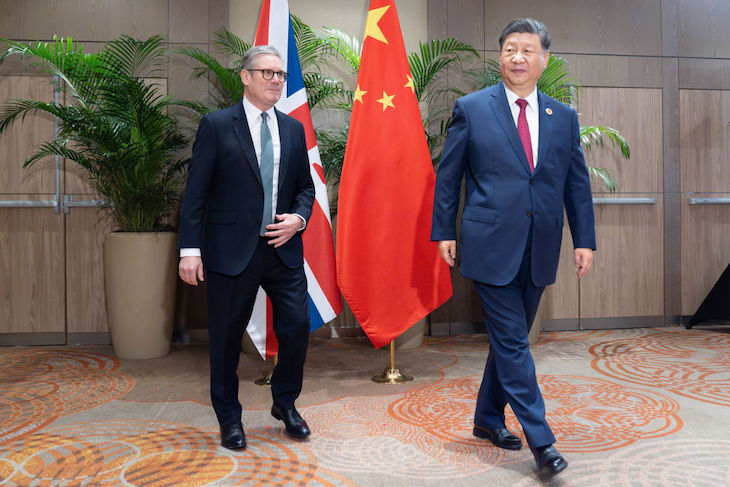
Keir Starmer and Chinese president Xi Jinping (Getty images)
When Dominic Cummings claimed this week that China had hacked into Britain’s most secret systems, the government rushed to deny it – understandably, given the political heat over the collapsed Chinese spy trial. But even if Cummings’ story proves false, the underlying truth remains: China has been systematically targeting Western networks for years, and extracting vast quantities of sensitive information. What is striking is not the allegation, but the reaction by a government so anxious not to call China a threat that it pretends not to see one. It is a surreal position, because the danger has been obvious for years.
The truth is that China poses a greater strategic threat to Britain than any state since the Second World War. It is not just a rival economy; it is an adversarial system seeking to rewire global power to its own advantage. And Britain, almost uniquely among the major democracies, still pretends that it can manage the danger with a few polite euphemisms.
China’s first weapon is economic. For two decades, Beijing has practised what might be called mercantilist innovation – the deliberate fusion of industrial espionage, state subsidy and global dumping.The formula is simple: acquire (sometimes, but not always, through theft) Western technology, turbocharge it with massive subsidies and cheap credit, and flood the world with exports that undercuts, and eventually destroys the opposition. A particularly relevant example when it comes to this government’s net zero aspirations is the solar-panel industry, where Western intellectual property was copied, production shifted to China, and foreign manufacturers wiped out.
This is not the natural rhythm of globalisation; it is a form of economic warfare. China’s dominance of solar, batteries, and telecoms has been achieved not by competition but by manipulation – a systematic transfer of Western know-how into state-directed conglomerates. Former FBI director Christopher Wray called China’s targeting, particularly of the US, as ‘one of the largest transfers of wealth in human history’.
The second threat is ideological and systemic. China’s leaders do not accept the legitimacy of the liberal international order built after 1945. Chinese leader Xi Jinping speaks openly about creating a ‘new global order’ that reflects ‘the realities of the new era’ – code for one where the West no longer writes the rules. Through the Belt and Road Initiative, the Shanghai Cooperation Organisation and the expanded BRICS bloc, Beijing is constructing an alternative world of finance, standards, and diplomacy, in which law yields to hierarchy and markets yield to politics.
For Britain, this is not abstract. Our prosperity and influence rest on an open, rules-based system that assumed that contracts will be honoured and trade routes will remain free. China’s model is transactional: obedience first, opportunity later. A world remade in Beijing’s image would leave Britain diminished, its companies sidelined, its diplomats excluded, its voice irrelevant.
The third threat is dependency. It is an astonishing but undeniable fact that Britain cannot currently rearm or decarbonise without China’s consent. Every advanced weapon – from missiles to radar to fighter jets – depends on rare earth elements, magnets and specialty materials overwhelmingly produced in China. More than 80 per cent of global rare earth processing capacity sits under Beijing’s control. The same applies to renewable energy: China dominates 70 per cent of the world’s lithium refining and more than 80 per cent of solar manufacturing.
This is not interdependence; it is strategic leverage. In any future crisis, Beijing could throttle our industrial and energy base at will. The Ministry of Defence’s ambitions to ‘rearm at pace’ and the Department for Energy’s green transition both dangerously rest on Chinese supply chains. Despite years of warnings, Britain still has no credible programme of mineral stockpiling, no industrial strategy for substitution, and no serious plan for allied sourcing.
Given these realities, why does the government still refuse to call China a threat? The first reason is economic delusion. Ministers still cling to the idea that China represents a vast commercial opportunity. In truth, it doesn’t. Very few foreign companies make durable profits there; intellectual property is extracted, markets are manipulated, and contracts are enforced only when convenient to China. Britain’s exports to the People’s Republic account for just 3 to 4 per cent of the total – less than we sell to Ireland or the Netherlands. Yet the myth of Chinese indispensability endures.
The same wishful thinking infects investment policy. Successive governments have courted Chinese capital for nuclear plants, energy grids and real estate, mistaking scale for virtue. But the question is not whether China can invest in Britain, but why we would want it to.There is no shortage of allies –Japan, South Korea, the United States, Europe – eager to invest in a stable, law-abiding market. The argument for Chinese money has always been a mirage.
The second reason is fear. Ministers are paralysed by the thought of Beijing’s anger. They have seen what happens to countries that cross China: Australia hit with tariffs on wine and barley; Japan cut off from rare earths; Norway punished for awarding a Nobel Prize to a dissident. So they whisper the word ‘threat’ in private but never say it in public, hoping to avoid retaliation.
Yet this logic is precisely backwards. If China is willing to use coercion against middle powers – who, we should remember, are in the main our allies – that is the strongest reason to harden our economic defences. This means building resilience and stockpiling critical minerals. Instead, the UK has chosen inaction. It neither confronts China nor prepares for coercion. The result is paralysis: a policy that offends our allies and reassures no one.
Britain’s China stance now combines the worst of both worlds. The government is too timid to deter, and too complacent to prepare.
China is the defining strategic challenge of the twenty-first century, and for Britain it is a direct and growing threat. It appropriates our ideas, undermines our industries, shapes the world order to its advantage, and holds the means to throttle our rearmament and our energy transition. And still, ministers dither.
This is not prudence; it is appeasement masquerading as nuance. A serious government would use the present calm to rebuild resilience, diversify supply chains, and align with allies on a coherent strategy. Instead, Britain has drifted into strategic denial – a country that cannot even name its greatest adversary for fear of causing offence.
It is, quite simply, a dereliction of duty. China really is a threat to the United Kingdom, and the longer our leaders pretend otherwise, the weaker we become.