Duas coisas são infinitas: o universo e a estupidez humana. Mas, em relação ao universo, ainda não tenho a certeza absoluta.
(Einstein)
But the tune ends too soon for us all (Ian Anderson)
During the Covid lockdowns of spring 2020, the pollution usually seen in India’s cities like Mumbai (above) suddenly cleared, leading to a negative side effect: some of the hottest temperatures ever recorded. (Photo by Mohd Zakir via Getty Images)
During the first months of the pandemic, in the spring of 2020, India’s government imposed one of the most draconian lockdowns anywhere in the democratic world. I happened to be in Mumbai at that time, where you couldn’t go more than half a mile from your home except for essential purposes. Unpleasant as this was, there was one positive side effect: the notoriously polluted skies of Mumbai—like those of other big Indian cities, from Delhi to Bangalore—suddenly became much clearer. With far fewer cars on the road, factories shut, and flights grounded, the amount of aerosols in the atmosphere fell to their lowest rate in 20 years.
Then came the negative side effect. That summer, India experienced some of the hottest temperatures ever recorded. Globally, the year 2020 was one of the warmest on record; the average temperature in India that year was 0.29 Celsius degrees hotter (roughly 0.52 degrees Fahrenheit) than during 1981–2010.
This is no coincidence. It is well known that aerosols make clouds bigger, brighter, and more reflective; when they decrease, more sunlight reaches the earth, which leads to higher temperatures. And a 2023 study showed how, during the pandemic, clearer skies across South Asia increased climate warming.
As we clean up the environment, we must be conscious of this trade-off. I was reminded of my lockdown in India a few weeks ago, when it was reported that an attempt to cleanse one of the world’s most polluting industries has, unfortunately, exacerbated global warming.
In January 2020, new shipping regulations were put in place by the International Maritime Organization, to reduce the permissible sulfur content of shipping fuel from 3.5 percent to 0.5. The intended effect was to reduce the sulfur dioxide emitted by maritime vessels by about 80 percent; the actual reduction was about 70 percent. The IMO’s expectation was that this would lead to “reductions in stroke, asthma, lung cancer, cardiovascular and pulmonary diseases.”
“Cutting sulphur emissions from ships will also help prevent acid rain and ocean acidification, benefitting crops, forests, and aquatic species.”
But according to a study released last month, the “abrupt reduction in shipping emission” had an unintended consequence. Sulfur dioxide has a powerful cooling effect on the planet, because it reacts with water vapor to produce aerosols, which help block the sun.
Led by Tianle Yuan, a scientist at the University of Maryland and NASA, this latest study therefore found that cutting emissions from shipping could warm the atmosphere by 0.16 degrees Celsius within a decade. (Aerosols vanish quickly from the atmosphere.) The 2020s are expected to be “anomalously warm”—and we already know that the year 2023 was the hottest on record.
“There is a trade-off between reducing aerosol pollution and additional warming,” Yuan told me. The well-known climate scientist James Hansen refers to this trade-off as a “Faustian bargain.”
“In terms of policy,” Yuan added, “we need a better understanding of the pros and cons of the impact on human health and climate/environment.” It is far more difficult to quantify the health benefits from the reduction of aerosols than it is to measure the additional global warming.
Yuan’s findings have been challenged, notably by Zeke Hausfather, a climate scientist at the Breakthrough Institute. “Yuan and colleagues are not too far off on the ultimate amount of warming that will result from the regulations,” he told me. “They just assume it will happen nearly immediately rather than over the course of decades as the ocean heats up.”
Importantly, he isn’t challenging the magnitude of warming that Yuan predicts as a result of these shipping regulations, but rather how quickly the warming will come about.
“More sophisticated models give a much smaller effect (0.05° C to 0.07° C or so) in 2023 than the 0.16° C they suggest in the paper,” he said.
There are other effects of reducing aerosols in the atmosphere. If you live in North America, you’ve probably noticed an uptick in wildfires in recent years. A recent study from the University of California, Riverside finds that reducing aerosols may increase wildfires—even more than a rise in greenhouse gases—because, it is thought, aerosol mitigation dries out plants more than greenhouse gases do, making them more flammable.
So, does all this mean we shouldn’t stop polluting? Is there some sense in which pollution is “good”? Should we actually inject aerosols into the atmosphere to slow down global warming—as some have suggested?
No, we shouldn’t go that far. Yangyang Xu, a professor of atmospheric sciences at Texas A&M University, told me: “The health benefits of cutting air pollution outweigh the negative impact of accelerating global warming.
“There is no basis for continuing polluting the air for the sake of ‘masking’ some global warming.”
This is especially true, he added, in heavily polluted countries such as China and India, where there is considerable loss of life every year due to respiratory illnesses.
The general consensus in the scientific community is that if we focus on reducing aerosols without also reducing greenhouse gases, global warming will only accelerate, so we need to channel our resources into eliminating both simultaneously. But when it comes to environmental concerns, aerosols may be a lesser evil—one that might even buy us time until we work out how to get other emissions under control.
Sou romeno. Nasci na Roménia em 2001 e desde 2007 resido em Portugal. Adoro este país maravilhoso que me acolheu e que tantas portas me abriu. Passaria aqui o resto da minha vida.
Há, porém, algo que ainda me faz muita confusão, nomeadamente a adoração que existe face à sangrenta ideologia comunista. Como romeno sei que o comunismo destrói vidas e famílias, apregoa o medo e vende a ilusão de uma igualdade assente na opressão e omissão do bem mais precioso, a liberdade.
Sei isto porque os meus antepassados viveram numa sociedade comunista onde a fé não podia ser livremente exclamada, e um pequeno empresário não podia sonhar em gerar mais postos de trabalho e mais capital, que posteriormente seria investido para que ele e a sua família vivessem melhor. Tão simples quanto isto. Sabem porquê? Porque o comunismo não passa de um sofisma.
Entendo o papel que os comunistas tiveram antes do 25 de Abril de 1974, porém não entendo o fechar dos olhos às atrocidades que os mesmos comunistas, que se consideram democráticos e solidários, têm perante os países onde a fome, o frio e as fugas em massa das respectivas populações para fora das fronteiras nacionais estão na ordem do dia. E, que fique bem claro, falta de informação não há. Não há porque, ao contrário do que acontece nos regimes comunistas onde a liberdade de imprensa é reduzida ou até mesmo “despedida”, nos países democráticos, liberais ou até capitalistas o ser humano tem acesso às fontes de informação que deseja.
A Festa do Avante decorreu nos passados dias 6, 7 e 8 de Setembro. Num país livre, onde o jovem pode optar por fazer o que a consciência lhe dita, sem medos de ser encarcerado num gulag por achar que o Primeiro-Ministro (ou secretário-geral de uma organização comunista, para ser mais apropriado a certas realidades), não é bem aquilo que o país precisa. E, mesmo assim, foram muitos os jovens que compraram as suas EP’s e sorridentes tiraram selfies ao lado da foice e do martelo.
Agora entre nós.. passa pela cabeça de alguém que uma foice e um martelo, juntos ou separados, exprimam paz, liberdade ou progresso? Não! Mais depressa um campo de trabalho forçado como existe num verdadeiro país comunista e como, infelizmente, já existiu na minha querida Roménia.
E se até agora vos disseram que nos países em que o comunismo fez-se sentir não foi de facto implementado um verdadeiro comunismo, meus amigos, não se enganem, foi do mais autêntico que já existiu.
Another side of the Olympic Games, beyond handball, judo and volleyball, which I followed more closely.
The winners of the triple jump: in third an Italian born in Cuba; secondly a Portuguese born in Cuba; and first a Spaniard born in Cuba.
Are there any doubts about where we are headed? Everything normal...
The boxing winner was "an Algerian" who was banned from the World Boxing Association in 2023. Now "she" has been accepted into the OJ. It seems that, after all, he is trans..., or bi..., or whatever!
Basically: An ex-man who obtained a freedom certificate to hit a woman, in public, officially
Are there any doubts about where we are headed? Everything normal...
Outra face dos Jogos Olímpicos, para lá do andebol, do judo e do voleibol que segui com mais atenção.
Os vencedores do triplo salto: em terceiro um italiano nascido em Cuba; em segundo um português nascido em Cuba; e em primeiro um espanhol nascido em Cuba.
Há dúvidas para onde nos dirigimos? Tudo normal...
A vencedora do pugilismo foi "uma argelina" que foi banida da Associação Mundial de Boxe em 2023. Agora foi aceite nos JO. Parece que, afinal, é um trans..., ou bi.... ,ou whatever!
Basicamente: Um ex-homem que arranjou carta de alforria para bater numa mulher, em público, oficialmente
Há dúvidas para onde nos dirigimos? Tudo normal...
Apenas depois de ter feito uma reclamação por escrito no livro de reclamações online (o que eles dificultam o protocolo...), a rapaziada tratou do assunto.
Exmos. Senhores:
Constato que os contentores existentes na Rua Mário Viegas em S. João da Caparica não são objecto de manutenção regular há pelo menos duas semanas, pelo que apresentam o aspecto que se poderá, ao vivo e nas fotos que anexo, ser constatado, com as consequências em termos de saúde pública que deverá - penso - ser do vosso conhecimento.
Na expectativa do cumprimento das vossas funções, subscrevo-me
Luiz Boavida Carvalho
(Dear Sirs:
I’ve notest that the existing containers on Rua Mário Viegas in S. João da Caparica have not been subject to regular maintenance for at least two weeks, so they present the appearance that can be seen, live and in the photos attached, with the consequences in terms of public health, which - I think - should be known to you.)
(Only after making a written complaint in the online complaints book (how they make the protocol difficult, lord), the guys dealt with the matter.)
What the Trump assassination attempt reveals about America
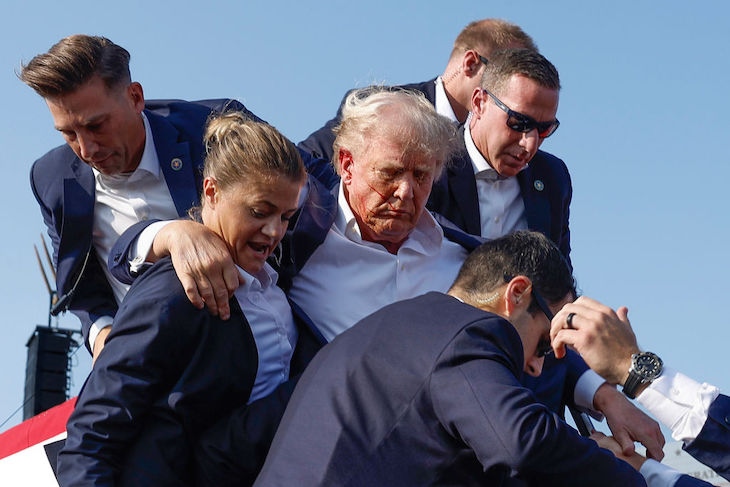
Donald Trump is bundled off stage following the shooting (Getty Images)
It has now been about 48 hours since Thomas Matthew Crooks, a socially isolated 20-year-old, attempted toassassinateDonald Trump, lightly injuring the former president, and fatally wounding an attendee at his rally.
A lot has already been said: about the danger of an escalatory spiral that will take this country ever closer to the brink, for example, and about the need to abjure all forms of political violence. A lot, for now, remains in the realm of speculation: the effect that this event – and Trump’s defiant reaction to it – may have on the upcoming election and, more pressingly, how someone like Crooks could have come within a literal inch of killing the most famous and controversial man in America. But one important question has, in the avalanche of media commentary about the assassination attempt, so far been mostly ignored.
It is in moments of tragedy or upheaval that the true state of a nation is often revealed. So what does the near-assassination of the most dominant politician in the country reveal about the state of the country, including the strengths on which it can count to get it through the next months, and the weaknesses that make it vulnerable?
Some of the news is good. Most Americans were saddened or outraged by the attempt on Trump’s life. This included his congressional allies and his millions of supporters, of course. Notably, it also included millions of Americans who deeply disdain him. Both Trump’s predecessor and his successor unequivocally condemned the attempt on his life; so did hundreds of elected officials, progressive organisations, and other political adversaries.
This may not seem like much: the willingness to accept that we mediate political differences at the ballot box rather than in violent clashes on the street is the minimum entrance ticket to a democratic society. But it is a minimum entrance ticket which many societies that, like the United States, are deeply polarised but, unlike the United States, are genuinely on the brink of civil war, refuse to pay.
A lot of the news, however, is bad. The bad news includes examples of people who reacted to Saturday’s events by glorifying violence, or by mocking its victims. One popular YouTuber with hundreds of thousands of followers, for example, seemed to celebrate the death of Corey Comperatore, an attendee at Trump’s rally who heroically shielded his family with his own body. The people who celebrated violence in this way were a small minority, and they were swiftly ‘ratioed’, and yet the thousands of likes they attracted demonstrate that a sizeable minority of Americans shares their rage.
One of the background conditions that has fuelled the rage of the past decade – and has in turn been fuelled by it – is a widespread sense that American institutions are failing. Even before we know the outcomes of the multiple investigations into the Secret Service which are now, for very good reasons, underway, it is clear that Saturday constituted an especially worrisome example of that kind of failing.
The Secret Service allowed a gunman to crawl onto a roof that was positioned fewer than 165 yards from the stage and have a clear line of sight to Donald Trump. Spectators spotted the gunman minutes before he was able to take his shot and tried to alert nearby security forces, but these failed to stop Crooks or to lead Trump to safety. A local cop did finally confront the shooter but reportedly retreated when Crooks threatened him with a gun, allowing him to take his shot. Some of the Secret Service agents shielding Trump after the attack appeared panicked and disoriented, with one struggling to put her gun into its holster.
The abject tactical failures of the Secret Service pose structural questions that urgently need to be answered. Why, even in the lead-up to Saturday, has the Service allowed a long series of comparatively minor infractions to accumulate? Did the Secret Service lack the necessary resources to protect Trump? And was the team on the ground sufficiently competent or experienced to handle the incredibly important task to which it was assigned?
As the old saying goes, one should never ascribe to malice what can fully be explained by incompetence. This motto seems especially apt as the dysfunction and incompetence of key American institutions mounts. But it also seems inevitable that, the more aptly this motto describes American society, the more often it will be disregarded. Massive failures of mission like that which occurred on Saturday practically invite wild conspiracism – and, boy, have wild conspiracies had a field day since the assassination attempt.
The first conspiracies came from Trump’s detractors. As soon as the first pictures of his injury emerged, some influential Democratic activists and advisors suggested that this was a false flag operation, designed to strengthen his appeal. Even after that, ‘Blue MAGA’ accounts on X/ Twitter and other social networks suggested that Trump had been hit by shrapnel rather than a bullet, or grasped at straws to deny that the shooter had once made a small donation to a progressive organisation.
But the extent of conspiracism was much worse on the right. Elon Musk raised the possibility that the Secret Service’s failure may have been ‘deliberate’ within hours of the attack. Jesse Watters, a prominent Fox News host, admonished his viewers to ‘be sceptical about what they hear,’ preemptively declaring that ‘we don’t trust the FBI.’ Marjorie Taylor-Greene predictably went even further: ‘this reeks of something a lot more sinister and bitter,’ she posted on Sunday. ‘There are too many things that do not make sense.’
Even the news about violence in the United States is a little less good than it might appear at first sight. It is true, as Rachel Kleinfeld explains in apodcast, that an overwhelming majority of Americans reject political violence. But it is also true, as she goes on to point out, that most people who engage in violence do so because they claim, whether sincerely or strategically, that they are merely defending themselves against the violent intentions of the other side. And while some extremists on both the left and the right have advocated violence in the last years, and even much more mainstream figures have made mealy-mouthed excuses for such violence in an unforgivable dereliction of civic duty, the extent to which they have done so is now routinely overstated on each side of the political aisle.
Parts of the left have justified some forms of violence in the last years. Movements like Antifa explicitly glorify political violence, reserving for themselves both the right to take action against anyone they consider fascist, and the right to determine who should be included in that category. Even politicians and media outlets that didn’t go so far as to explicitly endorse Antifa made excuses for real forms of political violence in the summer of 2020, when mass protests against racism whose participants really were mostly peaceful persistently devolved into highly destructive orgies of violence fuelled by a sizeable fringe of activists who really were anything but. Some actively encouraged it, such as when NPR ran an article glorifying looting as a legitimate form of political protest.
All of this is shameful. It must be called out and condemned without hedging or special pleading. But it also shouldn’t be inflated to imply that the Democratic establishment or the mainstream media has in general started to glorify violence. None of it justifies the hyperbole and hysteria to which Taylor Greene succumbs when she tweets that ‘The Democrats are the party of pedophiles, murdering the innocent unborn, violence, and bloody, meaningless, endless wars.…The Democrat party is flat out evil, and yesterday they tried to murder President Trump.’ Nor does it justify the comparatively mildclaimby J. D. Vance, whom Trump has today picked as his running mate, that it was Joe Biden’s rhetoric which ‘led directly to president Trump’s attempted assassination.’
Conversely, there is no doubt that parts of the Republican party and the conservative movement have glorified political violence in the last years. A succession of campaign ads showed high-profile candidates for office firing heavy-duty machine guns and promising, in the words of one early innovator in the art of gun-toting electioneering, to go ‘RINO hunting.’ And, yes, Trump himself has persistently toyed with endorsements of political violence – whether it be in the form of joking that cops making arrests should not be afraid to bump the head of suspects when throwing them in the back of police cars back in 2017, or more recently by portraying those who took part in the violent assault on Congress on January 6, 2021 as patriots.
All of this is shameful, all the more so for coming from the most senior officials within the Republican Party. All of this must be called out and condemned without hedging or special pleading, something that the conservative media ecosystem have notably failed to do. But here too, a kernel of truth, even one that is worryingly large, is no excuse for overstating the extent to which the other side embraces political violence. And that is something that the most senior Democrats, from Joe Biden on down, have consistently done.
Biden has, for example, repeatedly claimed that he decided to enter the 2020 presidential race after hearing Trump referring to the neo-Nazis and white supremacists who assembled for a deadly rally in Charlottesville in 2017 as ‘very fine people’. But while Trump was characteristically meandering and irresponsible in his remarks after that rally, he explicitly stated that ‘I’m not talking about the neo-Nazis and the white nationalists, because they should be condemned totally.’
A charge that senior Democrats have more recently laid at Trump’s feet is even more plainly misleading. Biden has repeatedly claimed that Trump threatened a ‘bloodbath’ if he should not be re-elected. The clear implication is that Trump is threatening that he would incite large-scale political violence if he should lose. But the context of the speech makes it clear that Trump was talking about the economy. He promised to protect American car manufacturing by massive tariffs, and implausibly predicted ‘a massive bloodbath for the country’ if these tariffs were not to be instituted.
The incentives of the mainstream media and the dynamics of social media manage to squeeze any important or nuanced question into a contest between two simplistic sides, a depressing distortion of reality even if one side happens to be much closer to the truth than the other. And so the question of the day has come to be whether it is appropriate to portray Trump as an existential threat to democracy.
Republicans are taking exception to the overheated rhetoric on the left. When theNew Republiccalls Trump an American fascist, and even puts a visual hybrid of Donald Trump and Adolf Hitler on its cover, they argue, not implausibly, that this runs the danger of inciting violence against him. If it was appropriate to resist Hitler by violent means, and Trump is his modern-day equivalent, then (so goes the tacit implication of theNew Republic’s cover), why shouldn’t it be legitimate to resist Trump by violent means?
Democrats are pushing back against this. Trump, they argue, not implausibly, really is a danger to America’s democratic institutions. He really did refuse to accept the outcome of the 2020 elections. He really did incite the mob that ended up storming the Capitol on January 6th. To blame Trump’s critics for inflaming the public mood when they are merely criticising his inflammatory actions, they charge, is a form of gaslighting.
Depressingly often, in American politics, both sides are badly wrong. In this particular case, it seems to me that both sides are mostly right.
As I have long argued, Trump is a populist who lacks respect for the basic rules of the democratic game. This put America’s democratic institutions under severe strain in his first stint in office, and it is likely to weaken them further if – as seems more likely by the day – he wins re-election in November. Democracy survives on respect for certain rules and institutions, such as the smooth transfer of power and a separation of powers. Trump has been consistently willing to ignore and undermine these fundamental norms when they clashed with his claim to be the sole legitimate representative of the people’s will.
At the same time, it is overly simplifying to insinuate that any politician with authoritarian tendencies is an all-out fascist, or that the process of democratic deconsolidation, which is depressingly common in the world, leads straight to the erection of gas chambers. It is perfectly appropriate – even in the aftermath of Saturday’s unconscionable attack on Trump – to warn about what his presidency may mean for America’s democracy. But there is never an excuse – even and especially when the stakes are truly high – for fear-mongering that distorts the exact nature of that threat.
America is a resilient country. It has many strengths, cultural and institutional, that its own citizens, blind to the even greater extent of dysfunction in many other parts of the world, tend to overlook. It is unlikely that the country will experience a genuine civil war anytime soon, and it has been heartening to see that the attempted assassination of Donald Trump has not, so far, led to any immediate outpouring of retaliatory violence. Some of the most dire predictions made in the last 48 hours have so far failed to come true and may, with the benefit of hindsight, turn out to be overly bleak.
But if moments of tragedy and upheaval reveal the true state of a country, the first draft of America’s report card puts it in danger of failing. Most Americans continue to abhor violence. Our mutual hatred still knows limits. And yet the mix of institutional failure, conspiracist thinking, and partisan fear-mongering is very potent. The risk that it may yet set in motion dynamics which overwhelm the decent instincts of most ordinary Americans remains very real.
This article originally appeared on Yascha Mounk’sSubstack.
Terunofuji, o 10º torneio depois de operações e outras lesões. Com um segundo lugar, o Takanosho.
Ura, Wakamotaharu, Wakatakakage, Hoshoriu (o mais tecnicista, mas mais mal encarado!), mas sobretudo Midorifuji, continuam a ser os meus preferidos, mesmo não ganhando.
Living off the beaten track was idyllic until one night last November. At 1 a.m. during a particularly heavy downpour, a group of hooded men came onto our property and tried to burgle us. Lulled into a false sense of security after three months in our rural home, we’d casually left our 25-year-old Land Rover Defender next to our barn, rather than locked away inside as it would normally have been.
The thieves had come prepared. Two of them scaled the fence and disabled our electric gates, ready for a quick getaway. Another one waited in the lane, engine running. The men opened the Defender’s door but were stopped in their thieving tracks by a metal security box that sits locked over the pedals. Luckily for us, they hadn’t quite brought all the right tools for the job.
Our newly installed Ring doorbell caught all of this on camera. Weirdly it didn’t actually ring an alert, nor did our dog bark. We all slept soundly, discovering the next morning the electric gates swinging gently in the breeze, the opening mechanism sawn clean through. It was weird and unsettling knowing that we’d had intruders, the only small comfort being that they hadn’t got away with their intended prize.But my overwhelming feeling was one of dread that they might come back the following night to finish off the job.
Kent Police, to their credit, responded quickly to my online report of the incident and requested our camera footage. But that’s all that happened. I wasn’t surprised. Policing of rural crimes is famously ineffective, so it’s no wonder that country folk sometimes take matters into their own hands.
You have to be of a certain age for the name of Tony Martin to resonate. He was a Norfolk farmer at the end of his tether after numerous break-ins and a lack of action by the police. One night, Mr Martin lay in wait for the thieves, cradling his shotgun. He ended up in prison for shooting dead a teenage burglar, but the case prompted an outpouring of anger from a public fed up with property owners being punished rather than the thieves. People spoke out saying that they, like Tony Martin, would have defended themselves if the police were unable to help them.
This was back in 1999, a more innocent time and crucially before everyone had a smartphone in their pocket. The Blair government pledged to inject more cash into rural policing, but 25 years on and now a victim myself, I’m wondering if anything has really changed?
In 2023, the New Forest villages of Lyndhurst and Minstead held the dubious honour of having the most unsolved burglaries in the entire country – not a single crime had been solved for three years. Residents posted incidents on WhatsApp instead of bothering to call 999, relying on each other for clues and evidence to try and catch the perpetrators, a kind of Neighbourhood Watch for the instant messenger age.
At our local pub a few weeks after our attempted Land Rover theft incident, we were invited to join one of these local and longstanding WhatsApp groups. ‘It’s really effective’ said the burly chap leaning on the bar holding his tankard, ‘as soon as you get any more trouble, just stick it on the WhatsApp and I promise you, three or four pick-ups with a couple of big blokes will do their best to be at your gates as quick as they can, day or night’.
I asked if that might not antagonise the situation if thieves were tooled up and intent on getting away with my property? ‘Nah’, he said confidently. ‘They get scared off easy enough when we turn up, it’s not worth the hassle for them – they’ll go elsewhere’. He said there was no point involving the police; much easier to use small village networks to report suspicious incidents and warn others that troublemakers might be in the area. That in itself, he said, acted as a deterrent to the criminals.
But what if they don’t get ‘scared off easy’ when the pick-up men arrive? What if the crims refuse to leave and want a fight? What if one of them gets fatally injured on my property? What if I get banged up like Tony Martin?
Government statistics show that rural crimes are much lower than those in urban areas, but that doesn’t tell the whole story. In a town you are surrounded by people, on foot, in cars, living next door, above or below – out in the sticks it’s a very different vibe. We do have neighbours – one sort of next door and another about half a mile away across an orchard. But I’m aware that if I were home alone and had sudden cause to scream, nobody would hear it. Hopefully, if I could get to my phone and alert my neighbours through WhatsApp, they would come to the rescue.
Why the Dominance of America’s Currency Is Harder Than Ever to Overturn
Cinta Fosch
The U.S. dollar is the most easily recognized, widely accepted, and ardently desired currency in the world. It is also much reviled for the power it gives the United States over international affairs. Washington wields the dollar as a weapon against its rivals by imposing sanctions and freezing assets. Even U.S. allies chafe at their dependence on the dollar, which exposes their economies and financial systems to the vagaries of U.S. policies. The country’s rivals and allies alike thus want to end the dollar’s dominance. They are eager to promote alternatives, including their own currencies. And the United States is doing all it can to help them.
The U.S. economy is no longer the colossus it once was. Its public debt is gargantuan and rising, and policymaking in Washington is erratic and unpredictable. Persistent threats of debt defaults undercut the perception that U.S. government bonds are safe. Worse still, the bedrock elements of the dollar’s strength—the rule of law, an independent Federal Reserve, a system of checks and balances—have been undermined in recent years by populist politicians who have chipped away at the country’s democratic institutions.
It would be no surprise, then, if the dollar were rapidly losing its power. But in fact the opposite is happening: the trends that would be expected to weaken the dollar, many of them driven by U.S. policy, are only strengthening its global dominance. The dollar remains on top in part because of the U.S. economy’s size and dynamism relative to other major economies. But more than that, although American institutions are fraying, those in other parts of the world are in no better shape, with populism and authoritarianism on the rise. Moreover, economic and geopolitical turmoil serves only to intensify the quest for safe investments, usually leading investors back to the dollar, which remains the most trusted currency. The United States’ financial markets are much larger than those of other countries, making dollar assets easier and cheaper to buy and sell.
Stay informed.
In-depth analysis delivered weekly.
The dollar is not fully immune to shifts in global economic and geopolitical power. But even as the dollar has lost some ground, the gap between it and any putative rival has only grown and shows no signs of stopping. China and India have become major economic powers, but their currencies have not picked up steam outside their countries. Although the global hierarchy of international currencies is shifting, many of these changes are improving the dollar’s relative standing by hurting its rivals even more. Turbulence in the world economy or global affairs—even if triggered or exacerbated by the United States’ own policy blunders—only enhances the dollar’s strength vis-à-vis alternative currencies. Almost nothing could change this any time soon.
WORTH THE RISK
Since the end ofWorld War II, the dollar has been the leading international currency in every respect—as a unit of account, a medium of exchange, and a store of value. Even by conservative estimates, at least half of all international trade is denominated in dollars, far more than in any other currency and much greater than the U.S. share of world trade, which is roughly 11 percent. It is the main invoicing currency and the top payment currency; roughly half of all international payments are settled in dollars. When a Chinese company imports iron ore from Brazil or a Brazilian firm purchases semiconductors from China, those transactions are almost always invoiced and paid for in dollars rather than in Brazilian reais or Chinese renminbi.
The dollar is also the principal global reserve currency; 59 percent of foreign exchange reserves in the world’s central banks are held in dollar-denominated assets, or assets whose face value and prices are all stated in dollars. There’s a reason the share is so large. Foreign exchange reserves act as a central bank’s rainy-day funds. They can be used to pay for imports or prop up the domestic currency when its value falls. Central banks in emerging-market countries have learned that large stocks of foreign exchange reserves help insulate their economies from volatile capital flows, and they try to keep reserves in assets that are safe and liquid. As a result, they buy dollar-denominated assets, which are available in large quantities and are always in demand and can therefore be bought and sold with minimal transaction costs.
And the greenback remains a key funding currency in global debt markets. When firms or governments in developing countries try to raise money in those markets, they are routinely forced to borrow in foreign currencies. This is usually because foreign investors lack confidence in the value of those countries’ domestic currencies and prefer to be repaid in dollars. Even some European companies and banks prefer to raise capital in dollars because the profusion of dollars makes that cheaper and easier. Two-thirds of securities issued by corporations outside their home countries are denominated in dollars.
These preferences reinforce one another. Foreign central banks’ demand for U.S. Treasury securities helps finance U.S. government borrowing, keeping U.S. interest rates relatively low. This in turn incentivizes foreign governments, corporations, and financial institutions to borrow in dollars. The widespread use of dollars in international trade encourages both developing and developed countries to hold reserves in dollars. During the 2008 global financial crisis, even the Bank of England and the European Central Bank borrowed dollars from the U.S. Federal Reserve.
But since that crisis, dollars have become an increasingly risky asset. The United States remains a dynamic and resilient economy, yet gross federal public debt is likely to exceed $35 trillion—roughly 125 percent of annual GDP—by the end of 2024, and Congress shows little inclination to curb spending or raise taxes. No one expects the U.S. government to walk away from its debt obligations. Still, the threat of even short-lived defaults, on top of the sheer and rising magnitude of debt, has caused rating agencies such as S&P and Fitch to downgrade U.S. government bonds.
The dollar is hostage to politics in more ways than one. During former U.S. PresidentDonald Trump’s term in office, the rule of law and the Federal Reserve’s independence—bulwarks of foreign investors’ belief in the stable long-term value of the dollar—took a beating. The U.S. system of checks and balances proved far too fragile and dependent on unwritten norms to maintain these investors’ confidence, prompting them to reevaluate their trust in the dollar and look for alternatives.
Washington has further jeopardized the dollar’s status by barring Iran, North Korea, and Russia from trading in dollars and thereby from accessing the international financial system. Following Russia’s invasion of Ukraine in 2022, the United States even froze Moscow’s foreign exchange reserves held in dollars. Whether or not this move was justified by Russia’s gross violation of international law, it undoubtedly left other central banks wondering whether their own dollar-denominated rainy-day funds would be locked up should their governments run afoul of Washington.
FALSE PROPHETS
But predictions of the dollar’s demise have greatly exaggerated the currency’s weakness—a fact made clear by its remarkable endurance. Analysts have warned for years that the dollar will lose out to other currencies, and yet none of them has displaced it. Consider the euro, whose inauguration in 1999 seemed to herald the end of the dollar’s unrivaled power. The eurozone was, after all, an economic area that stood toe to toe with the United States in terms of economic and financial market size. It had an independent central bank, and its members generally followed the rule of law.
At first, the euro did bite into the dollar’s shares as a payment and reserve currency. By 2009, the euro’s share of global foreign exchange reserves had risen to 28 percent, up from 18 percent in 2000, and the dollar’s share fell by a corresponding amount. But by the end of that year the euro’s progress had stalled. European governments lacked the political will to transform their monetary union into a broader economic and financial union, which would have required them to cede more power to eurozone institutions and exercise greater discipline in their own policies. The 2009 eurozone debt crisis laid bare the economic and political weaknesses of the monetary union. The euro’s share of global foreign exchange reserves eroded and has now fallen below 20 percent.
Counting U.S. dollar bills in La Paz, Bolivia, May 2024
Claudia Morales / Reuters
The Chinese renminbi has followed a similar trajectory. In 2010, Beijing began to actively promote the “internationalization” of its currency. With China’s rising clout in the world economy, this campaign quickly took off. By 2015, about three percent of global payment transactions were being conducted in renminbi—up from essentially zero just five years earlier. Chinese firms issued renminbi-denominated debt in Hong Kong and other financial markets, establishing it as a major currency on track to one day challenge the dollar.
Then the renminbi, too, stalled. China’s economy and stock market hit a rough patch in 2014 and 2015. Capital flight surged, and the currency lost value. Beijing responded by making it harder to take capital out of the country, spooking foreign investors. Since that period, the use of the renminbi in global trade transactions has increased slightly, but only for trade in which China is directly involved. The share of global foreign exchange reserves held in renminbi has stagnated, staying under three percent. And as China’s economy stumbles, with its leader,Xi Jinping, tightening his control and avoiding significant economic reforms, it is unlikely that foreign central banks and investors will trust renminbi-denominated assets.
Other countries have not even come close to challenging the dollar’s status. Economic and geopolitical forces have in recent years boosted some smaller reserve currencies, such as the Australian dollar, the Swedish kroner, and the Indian rupee, as has been observed by the economist Barry Eichengreen. But these currencies are still bit players in global finance, and their gains have come mainly at the expense of traditional reserve currencies such as the euro, the British pound sterling, and the Japanese yen. The dollar remains firmly on its pedestal, well above the fray.
NEW MONEY
Some politicians and analysts have suggested that countries should look beyond fiat currencies and toward gold and even cryptocurrencies such as Bitcoin, which they claim can serve as alternative “safe assets.” Both gold and cryptocurrencies are in scarce supply and therefore should hold value better than traditional currencies, which can be produced in infinite quantities. But scarcity alone does not ensure durable value. Although some central banks have been accumulating gold, its volatile value and the difficulty of converting large amounts of it into usable currency have rendered it largely unviable as a safe asset. And no central bank wants to take risks on cryptocurrencies, which remain entirely speculative.
Perhaps technology will do what governments cannot: undercut the dollar. Bitcoin and other cryptocurrencies have emerged as a libertarian alternative to official currencies issued and managed by central banks. Some governments are embracing digital currencies, as well.China, India, and Japan are already testing digital versions of their official currencies, and a digital euro is in the offing.
But with its highly volatile value, high transaction fees, and limited capacity for handling large volumes of transactions, Bitcoin has proved to be terrible for payments. New cryptocurrencies such as stablecoins, which get their stable value from backing by fiat currency reserves, are becoming more popular in both domestic and cross-border payments. But stablecoins backed by dollars are the only ones getting any real traction. Ironically, they are only making the dollar more prominent as a payment currency.
Fears that the introduction of digital renminbi could turbocharge the Chinese currency’s rise are unfounded. Most international payments are already digital, and the Chinese government has shown no indication of allowing its currency, in any form, to be freely available for use outside its national borders, since doing so would make it harder to control the renminbi’s value in foreign exchange markets. If Beijing did relax such controls, it would need to implement major political reforms—namely, instituting the rule of law and a system of checks and balances among different arms of government—before foreign investors began widely using its currency and investing in it. But such changes are unlikely.
STAYING POWER
Dollar doomsayers still believe the currency is on the brink of decline. They point to the cautionary tale of how quickly the dollar replaced the pound sterling as the dominant reserve currency after World War II. But that situation is not comparable to today’s. The United States has no serious rival that can match the combination of its economic and financial market size. Its institutions have deteriorated, but those of other major economies are in even worse shape.
Other quirks also make drastic changes unlikely. The turmoil unleashed by the global financial crisis led central banks and investors around the world to seek safety in the dollar, further strengthening its position. Foreign investors hold more financial assets in theUnited Statesthan American investors hold abroad, meaning the United States is a net debtor to the rest of the world. U.S. liabilities to the rest of the world are denominated in dollars, with many foreign investors willing to accept low returns in exchange for the safety of the dollar. American investors, by contrast, have been willing to bet on foreign assets that are mostly denominated in foreign currencies because those assets yield higher returns even if they are riskier. If the world turned away from the dollar and sent its value plummeting relative to other currencies, U.S. assets abroad would be worth more in dollars, since each unit of foreign currency would also be worth more dollars. Conversely, foreigners would take a beating on the value of their dollar-denominated assets when converted back to their home currencies. In other words, a plunge in the value of the dollar would result in a huge financial gift from the rest of the world to the United States.
In light of this scary scenario, countries around the world should surely have reduced their exposure to the “dollar trap.” But they have done just the opposite. From 2014 to the beginning of 2024, U.S. foreign liabilities grew from $30 trillion to more than $51 trillion, while U.S. assets grew from $24 trillion to just $33 trillion. In other words, the United States was a net debtor to the rest of the world to the tune of $6 trillion in 2014—and that amount has tripled over the last decade. The United States now has the rest of the world in an even tighter chokehold.
Another example of how the dollar is waxing, not waning, comes from the determination of the value of Special Drawing Rights, an artificial currency created by the International Monetary Fund (IMF) in 1969 that serves as a supplemental reserve for member countries. From 1999 to 2015, the value of the SDR was tied to that of four major currencies: the dollar, the euro, the British pound sterling, and the Japanese yen, with each currency having a particular weight in determining that value. The weights of the currencies in the SDR “basket” are based on a formula that takes account of a country’s GDP, its share of world trade, and the share of global foreign exchange reserves held in that currency. The weights sum to 100.
In a bow to China’s rising economic power, the IMF added the Chinese renminbi to the SDR basket in 2016. Based on the formula, the renminbi was assigned a weight of 10.9 percent in the basket, a share that would have to come from the shares of the other currencies. But virtually all of it came from the euro, the pound, and the yen; the dollar’s share was barely affected. The euro was the biggest loser, with its share in the basket shrinking from 37 percent to 31 percent.
The IMF adjusts the weights every five years to reflect changes in the variables that go into the formula. The latest revision, which took effect in 2022, bumped up the weight of the renminbi to 12.3 percent as the Chinese economy continued its progress, despite the hit from the COVID-19 pandemic. But once again, the dollar did not suffer. In fact, its weight increased by nearly two percentage points to 43 percent. Again, the other three currencies lost ground, with the euro’s share shrinking to 29 percent.
SAFETY AMID CHAOS
Economic and geopolitical factors are still intensifying central banks’ desires to diversify their foreign exchange reserves. But the reality is that the dollar remains too powerful and too ingrained in the global economy for states to consider switching to other currencies, because their status as payment and reserve currencies has eroded. And the United States boasts an economy that remains larger and more dynamic than that of almost every other country. Even if China were to someday rival the economic might of the United States, it does not have the strong institutional framework needed to compete with Washington.
Washington could overplay its hand, damaging the dollar’s standing. There might be a tipping point at which markets decide that the level and trajectory of U.S. public debt are unsustainable. Fearing a surge in inflation, which helps a government reduce the value of its debt obligations, domestic and foreign investors could dump U.S. Treasury securities. Further damage to American democratic institutions and the independence of the Federal Reserve, both potential outcomes if Trump were to be reelected, would reduce trust in U.S. financial markets and the dollar.
Paradoxically, however, chaos has proved favorable for the dollar. Any economic and geopolitical turmoil, even if unleashed by the United States, tends to lead investors worldwide to search for safety. And U.S. financial markets are the only ones large enough to meet their demands.
Rather than counting on economic and institutional frailties in other countries, U.S. politicians could reinforce the dollar’s dominance simply by playing their cards right. Economic policies that promote growth and financial stability, including through disciplined fiscal policy that reins in government debt, would help. Ensuring the Federal Reserve’s independence and more judicious use of financial sanctions would preserve trust in the dollar.
The story of the dollar is, ultimately, less about the United States’ strength than about the rest of the world’s weaknesses. Until that disparity changes, and seemingly no matter how badly the United States plays its cards, don’t expect the dollar to decline.