sábado, 15 de novembro de 2025

The Spectator - What will the Israel haters do now?

 (personal underlines)


What will the Israel haters do now?
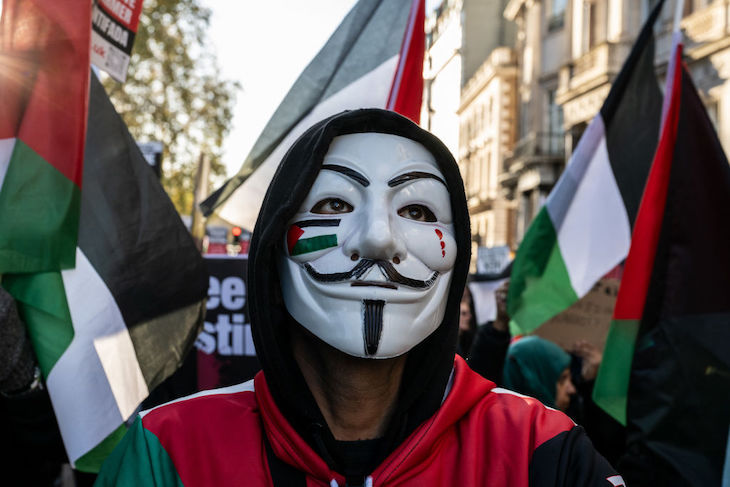
A pro-Palestine demonstrator on the streets of London (Getty images)

Normal people are cheering the prospect of peace in Gaza. Some might even raise a glass to Donald Trump for his valiant efforts to end this horrible war Hamas started. But there are others who will be feeling forlorn. The anti-Israel mob, to be specific. Won’t you spare a thought for this tragic community that built its entire personality around hating Israel – what are they going to do now?

There is an eerie silence in anti-Israel circles this morning. The people who spent the past two years hollering ‘Ceasefire now!’ seem strangely downbeat about the prospect of a ceasefire. No doubt that’s partly because they would rather eat hot coal than credit Trump with a geopolitical win. But it’s also because they feel the rug of relevance being pulled from under their feet. The brutal truth: peace will rob them of purpose.

It’s been clear for some time now that the fashionable animus for Israel is more than a political position – it’s a religious crusade. These people see Israel not only as a nation fighting a war they don’t like, but as a demonic entity, uniquely barbarous, the poison in the well of humanity. Israel has become a Satan substitute for a godless activist class, the devil against which they measure their own decency. If this war ends, so might their false religion.

They wear the holy garments of Israelophobia so that others will know the depth of their devotion to the cause: the keffiyeh around the necks, the Palestine flag draped like a pashmina over their shoulders. They repeat Israelophobia’s mantras, with little thought but great bombast. Witness how ‘From the river to the sea’ usurped ‘Trans women are women’ as the mating call of woke’s true believers.

They have their ritualistic ceremonies. A solemn march every weekend, the purpose of which is less to shape events in the Middle East – as if – than to make a spectacle of their own ethical rectitude. There is a millenarian feel to these depressing weekly trudges. At some they’ve even held up baby dolls wrapped in bloodstained shrouds to let the world know Israel is a baby-killing machine. It’s a grimly medieval ceremony masquerading as political activism.

Perhaps the most dangerous thing for the genuflectors to Israelophobia is that Trump’s peace deal shatters the founding lie of their fake faith – namely that Israel is hell-bent on genociding the Palestinian people. In truth, Israel has signed up for a deal that envisions a ceasefire soon and which expressly says that not one Palestinian will be forcibly expelled from Gaza. And so their church crumbles under the weight of its own calumnies.

If the deal works, if Trump and Israel bring peace and banish the anti-Semites of Hamas from public life in Gaza, what will these people do? How will they get their moral kicks? By what means will they advertise to the world their implacable virtue? What will occupy their every waking thought and inform their every political utterance if not that dastardly Jewish State and its ‘genocide’?

Think of poor Sally Rooney – will she now have to pontificate on some other global calamity? Sudan, perhaps? Or, indeed, the Irish government, which is maniacally obsessed with Israel – will it now have to worry its empty head about more trifling matters, like Ireland’s housing crisis and migrant crisis? And the keffiyeh classes, those turbo-smug appropriators of Arab headgear who you see in every coffee shop and art gallery – which garment will they don now to let onlookers know how amazing they are?

And poor Greta! She’ll have to go back to talking about climate change, won’t she? Having failed to ‘Save Gaza’, she’ll have to content herself with that oh-so-Nineties mission of saving the planet. Boring! One thinks, too, of the YouTubers who have monetised their hatred for Israel, spending every hour of every day slamming the Jewish State for clicks and bucks. Blessed be the peacemakers, sure, but won’t someone think of the videomakers?

I, personally, am looking forward to the looming crisis of meaning among a left that foolishly and feverishly devoted itself to hating Israel. In the absence of this infernal war, these people will be forced to peer into the cavernous depths of their own souls. They will have to shake themselves back to reality, leave behind their half-formed faith, and re-engage with the world anew. It will be tough, but it will be good for them. And for the rest of us too, who might finally be spared their anti-Israel caterwauling.

Of course, there’s another possibility – that they will double down. That they will carry on traipsing against Israel, zombie-style, even when peace descends. Indeed, Your Party, the Zarah Sultana/ Jeremy Corbyn freakshow, is advertising a march in London this weekend. ‘We march on’, the flyer says, ‘until apartheid falls’. For two years, they screamed ‘Ceasefire now!’ – so why are they still marching? I’m tempted to go and laugh from the sidelines. Who’s with me?

Livros - Charlie Brown


The spectator - What makes a gentleman?


(personal underlines)

What makes a gentleman?

It’s more than simply opening doors or paying for dinner

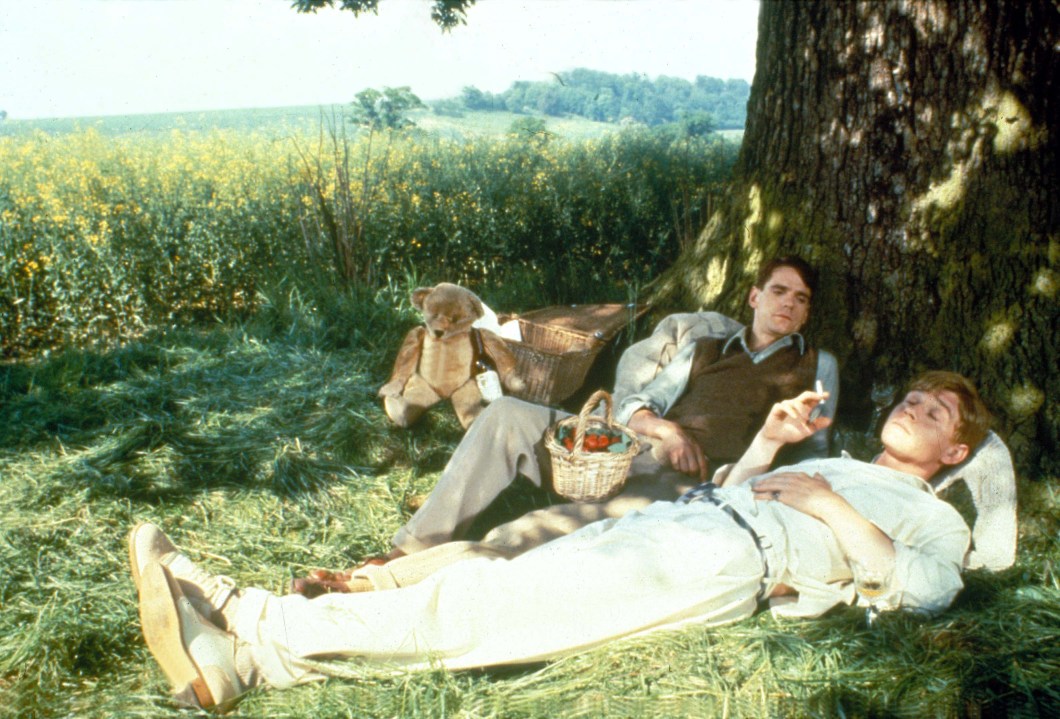
Jeremy Irons and Anthony Andrews in 1981's Brideshead Revisited [Alamy]

The venerable magazine GQ, or Gentlemen’s Quarterly, has issued some 125 diktats about what it takes to be a gentleman in this world of Zoom calls and equality. GQ is, however, no longer quarterly, and some might say it hasn’t been read by gentlemen for some time. Ought we, then, to listen to it?

Many of its ‘expert’ pronouncements are baffling: what is ‘popping a Zyn’? Most of the suggestions are about bringing fancy olive oil or luxury candles to parties. (Note to readers, though you won’t need it: don’t.) It also suggests that gentlemen should beclothe themselves in ‘loungewear’, a word which ought to make anyone shudder. Well, I’m sorry, but unless it’s a silk dressing gown from Jermyn Street, I think not. 

The audience, though, is primarily American and internet-based, and once you understand that the intention of the guide is to prevent men from taking their shoes off on long-haul flights, then one looks a little more kindly upon it. 

But what, then, is a gentleman? It’s more complex than simply opening doors for others, or, as GQ would have it, picking up the tab for dinner. What isn’t gentlemanly is obvious: public transport brings them out, as rainstorms do slugs. The oik on the Tube who didn’t stand up for my pregnant friend is a case in point.

It isn’t, necessarily, to do with birth. ‘Gentleness’ can be learned and imitated, and always has been. Traditionally, the ‘gentry’ consisted of an untitled, landed class immediately below the nobility, and hovering just above the trades, distinguished by bearing arms. These boundaries, though, are more porous than you’d think. Think of the Guinnesses – brewer to baronet to earl in a handful of generations. William Shakespeare, the son of an alderman, with some tenuous connections to the ‘gentle’ Arden family via his mother, successfully achieved a grant of arms for his father. Heraldic doctrine prescribes that the grant did not confer gentility, but confirmed what was already there. Many a tradesman has become ‘gentle’; and it works the other way, too, as many a gentleman’s son has ‘fallen’ into trade. Gentility can be swiftly unlearned: oiks exist among the landed classes, too.

In the popular imagination, it is not easy to distinguish a gentleman from a snob. Yet there are marked differences. It’s true that there are correct modes of speech and behaviour. Some shibboleths can’t be helped, as they are deeply ingrained into the psyche: how to pronounce Featherstonehaugh, for example, or not wearing a wing collar for a black-tie dinner. That a gentleman should know these things is clear; that one should not think less of others for their ignorance is more so. Other ‘rules’ are idiosyncratic. I insist that anything which requires new ‘kit’ (apart, obviously, from riding) is infra dig, particularly if it involves bicycles.

While GQ is to be commended for trying to stem the loutish tide, being a gentleman is, like Confucianism, a way of life. It boils down, not to listicles and club ties, but to considering others before yourself. This is deeply moral, and, dare I say it, even Christian. That’s why, as has been the case since ‘gentleness’ began, its true forms are found everywhere. A real gentleperson understands instinctively, and will leap up to offer that pregnant woman a seat. And – even if the chap in question is covered head to toe in Lycra – he’s still, in my view, a perfect gent. Although not if he’s in ‘loungewear’. We must maintain some standards.

Livros - Discursos II (Oliveira Salazar)


segunda-feira, 10 de novembro de 2025

The Spectator - Donald Trump is an awful person – but a brilliant president

 (personal underlines)


Donald Trump is an awful person – but a brilliant president

US President Donald Trump is a bully - but his methods work (Getty images)

Donald Trump is a bully. He is a braggart. He is venal. But, as this week’s ceasefire deal between Israel and Hamas shows, he is also capable of acts of uniquely brilliant statecraft. The US president is a master at using the hard power of his office to force changes that make the world a better place.

Fascinatingly, because it shows how we tend to look at politicians through a two-dimensional prism, those words could also be applied to another, relatively recent, US president: Lyndon B Johnson. Trump and LBJ both demonstrate how loathsome people can nonetheless do good things.

We are familiar with the many examples of Trump’s appalling behaviour, such as when he was caught on tape talking about kissing women and grabbing them between their legs: ‘I’m automatically attracted to beautiful – I just start kissing them. It’s like a magnet. Just kiss. I don’t even wait. And when you’re a star, they let you do it. You can do anything. Grab them by the p****. You can do anything.’

Compared with LBJ, however, Trump is an amateur. To read Robert Caro’s magisterial multi-volume biography of the former president (the good news for those of us who have waited years for the final volume is that Caro has said he has now written over 900 pages of it) is to marvel at what a monster LBJ was. He was obnoxious, vulgar, self-absorbed, cruel and insecure. He humiliated his own staff and others for pleasure.

But he was also – as is Trump – deeply charismatic. Like Trump, he was able to focus on what actually mattered about an issue, disregarding years of received wisdom and irrelevant constraints. And like Trump, he was a brilliant communicator who had people hanging on his every word. (Unlike Trump, LBJ also had an exceptional intellect, and could grasp the important minutiae of policy in an instant.)

Meetings for LBJ were power plays. He would fart, burp, pick his nose and scratch his crotch. He invaded people’s personal space as a tactic to overpower them. Ben Bradlee, the former editor of the Washington Post, described how LBJ groped its owner Katharine Graham and would ‘bump’ up against the breasts of female Washington Post writers. He would keep the door to his toilet open as he relieved himself so he could be seen. Arthur Goldschmidt, a United Nations official, was in the Oval Office when LBJ walked into the toilet, ‘took a crap, then shaved and showered, all the while continuing his conversation as though what he was doing was the most normal thing in the world.’

LBJ was notorious for using aphorisms such as ‘straight as an Indian shits’. He once described US economic policy as ‘the worst thing that’s happened to this country since pantyhose ruined finger-fucking.’ He would check on the looks of potential female appointees and would comment if female White House employees gained any weight. He repeatedly used the N word, describing to the manual labour of his youth as ‘n—-r work.’ In a 1964 telephone conversation about his prospects of winning Texas in the presidential race, he said: ‘I think I can take every Mexican in the state and every n—-r in the state.’ (He had his Oval Office calls and meetings secretly taped, like his successor, Richard Nixon.) In a 1967 meeting in the Oval Office about possible black candidates for the Supreme Court, Johnson said: ‘When I appoint a n—-r to the bench, I want everyone to know he’s a n—-r.’ When there was rioting by blacks in Los Angeles in 1965, Johnson said he worried that, ‘Negroes will end up pissing in the aisles of the Senate.’

And yet LBJ was one of the great US presidents, whose time as Senate Majority Leader prepared him brilliantly for ensuring that his massive legislative agenda for civil rights, healthcare and welfare passed. Many of his programmes remain in effect today. Paradoxically, given his personal behaviour, his civil and voting rights legislation changed the US. He got the Civil Rights Act through Congress almost single handedly, at the cost of his own political power and the support of many of his political friends.

LBJ was, in other words, a shit who used his obnoxiousness for good ends.

Trump isn’t in the same league as LBJ, either as a shit or as a politician (at least yet). But like his predecessor, the very personal qualities which make him an unpleasant man give him an ability to change the world for the better. The Abraham Accords would not have happened without Trump being Trump. Nor would any other president have simply ripped up the appalling JCPOA, the Obama nuclear deal with Iran.

And now we have the Gaza deal – or more accurately, Trump’s Gaza deal. You might not like Trump, but the same qualities that make him so unpleasant, are changing the world for the better.

Livros - Augusto Cid


The spectator - First they came for the Jews…

 (personal underlines)


First they came for the Jews…

It was moving to watch Keir Starmer announce this week, from a corridor in Downing Street, that his government has decided to recognise a state of Palestine. Starmer took this bold action at the same time as his French, Canadian and Australian counterparts. But as with Emmanuel Macron, Mark Carney and someone called Anthony Albanese, he seemed to be labouring under a number of misunderstandings.

The first was that it makes any difference. Starmer and his counterparts overseas appear to be under the misapprehension that the creation of states still lies in their hands. I had thought that the present generation of leftists looked down on imperialist western powers making their colonialist interventions in foreign regions. But apparently not if the ‘state’ in question is called ‘Palestine’.

The second reason the announcement was so unimportant is that not one of the prerequisites for Palestinian statehood exists. There is no coherent Palestinian leadership. Nor is there any contiguous Palestinian territory. There is now vague insistence on elections, but the last time the Palestinians had an election they voted in Hamas.

There is no agreement on what relations between ‘Palestine’ and its closest neighbour would be. And there is not even any agreement on ‘Palestine’s’ capital. Who will oversee education in this new state? Will it be another wonderful UN organisation, which allows jihadists to indoctrinate another generation of Palestinians into the idea that their highest purpose in life is to eradicate the Jews? Will there be an airport, or an army?

Perhaps Starmer, David Lammy and Yvette Cooper have a clear plan – or ‘roadmap’ – to answer all of these questions, also explaining their precise population swap proposals for areas A, B and C of Judea and Samaria. And I am assuming that after our government has worked out whose territory is whose and let the locals know that they are ready to send British troops to sort it out, there will be an enormous amount of good feeling in the region, on all sides, towards the arrival of these British protectors.

So what exactly is the point of recognising something that does not exist and will not be agreed on? Hamas responded to the announcements by thanking Starmer and his counterparts. In their eyes, statehood recognition is a reward for the massacres they carried out on 7 October 2023 and the two years of war that have followed. It is a terrific lesson to have taught the terrorists in Gaza, as elsewhere, that all you have to do if you want to gain a state you repeatedly rejected is to break into villages and murder and rape your way through them, taking hostages along the way. It rather amazes me that, given the success of Hamas’s actions, people with a much greater cause for statehood – such as the Kurds – do not decide to go a-raping and a-burning in neighbouring villages too. But perhaps that is a point for another day.

In the meantime, it took the US secretary of state Marco Rubio to make the point that none of our politicians would: the principal reason these governments have behaved as they have has nothing to do with international affairs. Previous governments have tried for more than a century to persuade the Palestinians to accept a state which lives beside its Jewish neighbour. Every iteration of Palestinian leadership since then and right up to this moment is in agreement that a state of Palestine must consist of all the neighbourhood – including Israel – and that this Palestinian state must be entirely clear of Jews.

So, no, none of this has anything to do with a negotiating breakthrough. It has to do– as Rubio said – with domestic political pressure in each western country. As well as pointing out that these ‘recognitions’ have helped derail negotiations with Hamas for their surrender of the remaining 48 hostages, Rubio observed that Britain and co only recognised a state of Palestine because our country’s immigration policies mean we have been ‘flooded with foreigners who have become politically active and are insisting their government do these sorts of things’.

That is not language that any British politician would like to use. It would lead to tortured debates on the sofas of the BBC if they did. Yet Rubio is right. In the past two years I have spent time in each of the countries that just recognised Palestinian statehood and in each of them the same pattern can be observed. From Canada to Australia, the UK to France, each of these four countries has seen repeated disturbances by Muslim immigrants demanding a ‘free Palestine’.

Of course it isn’t just immigrants. It is also the strange lost souls who have decided that their life’s purpose can best be found by dyeing their hair blue, wearing some Palestinian terrorist-chic headscarf and insisting that no one will be free until ‘Palestine’ is free.

If you think that the intimidation by these curious mobs doesn’t have an effect, cast your mind back to how a Palestinian protest altered the course of parliamentary procedures in Westminster early last year. As the then prime minister Rishi Sunak said at the time, there is a ‘growing consensus that mob rule is replacing democratic rule’ – an observation that was no sooner made than it was ignored. Or look at Italy, where Giorgia Meloni’s government failed to join in this week’s statehood stampede. In response, a mob marched through the centre of Milan in their regulation keffiyehs and smashed up whatever buildings they could find.

There may be a day when a Palestinian state could exist. But the conditions for that state to exist do not currently exist. Starmer and the others have done nothing to help peace in the Middle East. But I suppose they have managed to put off facing up to our own problems for another day, and kept a degree of peace at home – for now.

Livros (últimos)


Reflexão - LBC (mensagem ao Diogo e João Novo, pela morte do pai)

 (ENVIADO AO DIOGO NOVO E JOAO pela morte do pai )


Queridos amigos:

É, naturalmente, com tristeza que vos contacto neste momento difícil. Porque nós todos, de uma forma ou de outra, já tivemos de passar por momento análogos, não poderei deixar de me solidarizar convosco. 

Desculpem-me a mensagem tão pessoal. 
Continuo com esta mania de não generalizar momentos que me parecem destinados, definitivamente, a estar resguardados numa área especial. Cada pessoa sente, um momento, à sua maneira. Sempre que vivenciei momentos destes e que tive a responsabilidade da decisão, fi-lo com o recato e a descrição que então decidi. Não imagino o vosso sofrimento, mesmo sabendo de antemão que, desde há tempos, se tinha como um desfecho previsível.

O Sr. Luís era uma pessoa boa. Simples. Ao fim de umas dezenas de anos de vida, creio que se consegue ter esse distanciamento e distinguir esta qualidade única que dia a dia vai rareando. Uma pessoa que se dedica à família e a outros, como ele, só pode ter uma formação daquela que nós, certamente escolheríamos, caso nos fosse dada essa prerrogativa. Nos poucos momentos que privei com ele, quase que fiquei com inveja do João e do Diogo. Mesmo com aquela forma peculiar de exteriorização, era evidente o seu envolvimento e empenho para tudo aquilo em que a família se empenhava. E de que forma ele se empenhava e vivia o sucesso de todos vós!! Estes momentos, penso e defendo, são momentos particularmente pessoais em que, independentemente da solidariedade de todos aqueles que gostam de nós desejam evidenciar, são por demais difíceis de vencer, muito mais se com a presença dos que se entendem juntar-nos. Peço desculpa desta perspectiva pessoal, se não egoísta. Se sou habitualmente parco em oralidade, como bem sabem, quando estamos juntos, entendo que aqui, neste momento, e porque assim o sinto para convosco, devo demonstrar toda a minha solidariedade e o que me vai na cabeça. Desculpem este longo “desabafo”, mas só o faço porque gostei dele do pouco que vi e convivi. E, claro, porque apesar de afastados, vos tenho de perto. Um abraço amigo. Luiz

Reflexão - LBC (as presidenciais)

Lá vão os comentadeiros, comentatretas e afins espalhar que eu perdi todos os debates com aquelas três sumidades porque sou populista, fascista, xenófobo, etc.

e a carneirada a acreditar...


domingo, 9 de novembro de 2025

The Spectator - The rise of ridiculous doctorates

 (personal underlines)


The rise of ridiculous doctorates

At least the taxpayer didn’t have to fund my PhD

(Getty)

To a certain extent, all doctoral theses are a bit ridiculous – and therein lies their genius. I am allowed to say this because I spent four years of my life researching French Catholicism’s engagement with the first world war for my doctoral thesis, which I nattily entitled Calvary or Catastrophe?

Back then, I was a baby academic hoping for critical acclaim and my own office. I’ve long since been disabused of this dream and have left academia’s dreaming spires behind to become a journalist – a profession that offers me neither my own office nor critical acclaim, but a great deal of online abuse. 

And while I don’t expect anyone ever to read my PhD (although you can DM me any time for a copy), I believe that it had some slim critical justification. I also went to graduate school in America and received a five-year teaching fellowship from a private institution. I am happy to say that no taxpayers were harmed in the creation of Calvary or Catastrophe: French Catholicism’s First World War.

Not so for the millions of taxpayers in this country who are on the hook to pay for the Arts and Humanities Research Council’s (AHRC) increasingly bizarre list of funded projects. Founded in 1998, the AHRC receives £70 million in public funding every year to ‘uncover what it is to be human and the conditions which allow us to flourish or falter’, according to their website. Funded PhDs, classed as studentships, typically last 3.5 years at a cost of roughly £20,000 per year paid to the student, while the institution in receipt of the funding will receive anything from £5,000 to 6,000 in tuition fees and ‘research training support grants’.

When it emerged that Nadia Yahlom, a PhD student at the University of Westminster writing an AHRC-funded doctorate on ‘a participatory audiovisual exploration of haunting in Palestine’, was seen cutting down ribbons for Jewish hostages, the funding body was rightly put under scrutiny. In her thesis outline, Yahlom writes that ghosts ‘are more than simply symbolic’. So, might one add, are the ribbons for Jewish hostages – but maybe that’s another PhD project altogether.

Dig into the list of current AHRC-funded projects and the Haldane principle – whereby researchers make the research decisions – begins to falter, if not entirely collapse. Current projects include ‘Lesbian? “She no Lebanese. She Punjabi!”: Tracing the experiences of working-class, queer British South Asian women, 1970s to 1990s’ by Soumyaseema Mandal at Royal Holloway, University of London; ‘rub rub rub rub rub rub brush brush quiver oh hello, you: Queer Captioning as Material’ by Jessa Mockridge at Kingston University, London; and, my favourite, ‘Animals as builders: Exploring animal buildings as sites of agency, rights, and politics’ by an unnamed student also at Royal Holloway – who clearly needs to read The Wind in the Willows. Up north at Northumbria University, the AHRC has also funded a PhD entitled ‘Menstruation at the Movies: A History of Stigma and Shame from 2000 to 2022’, a work that examines how ‘the analysis of menstrual representation in film has been under-explored for over a decade’.

PhDs are seductive, but only as an idea – in practice they’re deeply unsexy. Publicly, the reason I gave for embarking on one was the naïve hope that I might produce a masterpiece of intellectual research – imagine little old moi, changing the cultural conversation. Privately, I think it’s simply that I wanted respect without having to do a nine-to-five in an office. 

Grifters like me aside, there are simply too many people doing PhDs now – approximately 113,000 in the UK, a near-record number – for them to have the gravity they used to, particularly in the humanities. Businesses complain that there is a shortage of high-level skills, gesturing to the fact that PhDs are not worth the candle when it comes to their bottom line. And good luck, is all I can say, if you decide to look for a job outside academia once you have completed your doctorate: most employers will bin your CV the moment they see those three little letters, assuming – rightly or wrongly – that you will be too hoity-toity for the task in hand.

I certainly wasn’t too hoity-toity to do another job, but after five years of graduate school I was perhaps a little unused to conventional working hours. From my desk, I can see the spine of my doctorate (printed at vast personal expense) winking away at me. But I must remember that my love affair with academia ended when I was tasked with revising the footnotes and endnotes for my masterpiece. Now, perhaps, I could get AI to do that for me at the touch of a button. All that remains is for me to submit the AHRC application for my next doctorate: ‘Spectral theories of AI and time in the kaleidoscope of rural postmodern motherhood’. I just know it will get the funding.

The Spectator - The increasing fear felt by Britain’s Jews


 (personal underlines)

The increasing fear felt by Britain’s Jews

If you walked down the Strand in London on Tuesday this week you would have been greeted by hundreds of people outside King’s College London. The gathering was organised by students from KCL, the London School of Economics and University College London. They chanted ‘Intifada, intifada’ and ‘Long live the intifada’. They had chosen the day well – Tuesday was the second anniversary of the 7 October massacre, in which some 1,200 Israelis were killed and hundreds more taken hostage.

Tuesday’s hate-fest was not, of course, an unusual event. The first demonstrations in support of the 7 October massacre of Jews took place in west London on the day of the massacre itself. And the protests have not stopped since. In fact, they have only swelled in number.

For two years now, people in London, Manchester and other cities across the UK have had to put up with weekly, sometimes daily, parades of people celebrating the killings and spreading the libel – the lie – that the Jewish state of Israel is carrying out a ‘genocide’ in Gaza. Indeed, even during the first major protests in the UK these same protestors were already spreading the claim that Israel was committing genocide. This was before the Israel Defence Forces had even entered Gaza with the aim of finding the hostages and destroying Hamas.

The seeds sown by these lies flowered quickly. On 15 October 2023, a 45-year-old asylum seeker from Morocco – Ahmed Alid – broke into the bedroom of his housemate, a Christian convert from Islam, in Hartlepool. He hacked at Javed Nouri while he slept. ‘Allahu akbar,’ shouted Alid. Fleeing the scene, still armed with a knife, Alid then ran into the street to target whoever he could find. He ended up stabbing to death a pensioner called Terence Carney. Alid subsequently told the police he had attacked Nouri because he was an ‘apostate’ and had killed the passing pensioner because Alid wanted ‘Palestine to be free from the Zionists’ and ‘because Israel was killing children’.

Last week in Manchester the desire of the protestors to ‘globalise the intifada’ had another success. On 2 October, 35-year-old  Jihad al-Shamie chose the Jewish religious day of Yom Kippur to carry out an attack on the Heaton Park synagogue. After trying to access the building as the congregation was heading in, he ended up going back to his car and ramming it into the Jewish worshippers, then getting out and stabbing at them. His shouts included ‘Allahu akbar’. A 66-year-old congregant, Melvin Cravitz, was among those killed and wounded as a result of al-Shamie’s murderous spree. As al-Shamie was trying to break through the synagogue’s doors, held shut by security and congregants, he shouted that this was what the Jews ‘get for killing our children’.

Al-Shamie, a British citizen of Syrian origin, was subsequently shot dead by police. His family said that they condemned his actions. But it soon became clear that his father – a trauma surgeon – had responded to the 7 October massacre by praising the terrorists of Hamas as ‘Allah’s men on earth’ and claiming that the actions of Hamas’s rapists and murderers that day ‘proved beyond any doubt’ that Israel would be destroyed.

In the immediate aftermath of al-Shamie’s attack, police said that they were searching for a motive. Until the attacker’s name came out and turned out literally to be ‘Jihad’, the BBC speculated that the attack may have occurred due to an increase in rhetoric from ‘the far right’. Home Secretary Shabana Mahmood told GB News: ‘The only person responsible for this attack is the attacker himself.’ In fact, attacks like this happen for a whole range of reasons – not least an increase in the rhetoric and lies of people who have spent decades spewing hate against Jews in general and the world’s one Jewish state in particular.

Hate crimes against Jews in Britain have almost doubled in the two years since 7 October 2023. The peak came in the six months after Hamas’s bloody attack (2,019 incidents) and reached the second highest on record in the first half of this year (1,521 recorded incidents, according to the Community Security Trust).

Even in NHS hospitals, Jewish people no longer feel safe. A top doctor was suspended last month after a series of ‘anti-Semitic’ tweets. Dr Ellen Kriesels, a consultant paediatrician at a north London hospital, described Hamas as ‘oppressed resistance fighters, not terrorists’. The account linked to Dr Kriesels also claimed that efforts ‘to frame the Jews as victims’ were ‘ridiculous’ and ‘excruciating’. Another NHS surgeon was this week struck off after referring to another social media user as ‘circumcised vermin’, while a junior doctor who made a ‘slit your throat’ gesture to Jewish protestors escaped suspension after an initial tribunal found she had a ‘right to freedom of expression’.

Security at schools has also been beefed up. ‘No other faith group, as far as I know, has to have a level of protection in its places of worship, in its schools, in its community buildings,’ Richard Verber, from the United Synagogue charity, told Reuters. ‘We’re talking fences, we’re talking spikes on rails, we’re talking barbed wire, we’re talking CCTV, we’re talking about them all being plugged into local police forces.’

In reality of course any hate crime figures only scratch the surface of the problem. They do not take into account cases such as the ongoing trial of Walid Saadaoui and Amar Hussein, from Wigan, who appeared in court in London in May last year. They stand accused of planning an Islamic State-inspired machine-gun terrorist attack against Jewish communities in north-west England. Both have pleaded not guilty to the charge of preparation of terrorist acts.

Data on anti-Semitic incidents also necessarily cannot cover the unknown number of Jews who have felt unable to go into the centres of British cities for the past two years because of the weekly anti-Israel protests which have continued unchecked – or the number affected by the police stopping visibly Jewish people from being allowed in the vicinity of such protests.

From early October 2023, it was clear where all this would lead. The first marches on the streets of London and elsewhere included open calls for ‘jihad’, ‘intifada’ and for ‘Muslim armies’ to arise. The incitement has only escalated in the two years since. In June this year the still un-banned Khomeinist Islamic Human Rights Commission held a march which included an image of the Supreme Leader of Iran, Ayatollah Khamenei, accompanied by the slogan: ‘Choose the right side of history.’

Back in late October 2023, the then home secretary Suella Braverman described the weekly protests going through British cities as ‘hate marches’. She was roundly condemned for this by – among others – our now Foreign Secretary. Yvette Cooper claimed that Braverman’s use of the term ‘hate marches’ was ‘irresponsible’.

In the wake of the Manchester synagogue attack last week, our current Home Secretary Ms Mahmood finally joined the growing number of voices calling for protestors to think again about the following day’s planned anti-Israel demonstrations. The organisers of these events – in Manchester and London – were told that their actions could divert police resources at a time when synagogues and other Jewish sites required an increased police presence for protection.

Even Metropolitan Police Commissioner Mark Rowley suggested that ‘some might say’ the planned anti-Israel demonstrations ‘lack sensitivity’. But of course the protests went ahead anyway. Indeed, within hours of the Manchester synagogue attack, hundreds of protestors organised a rally against Israel on Whitehall. One of the protestors was quoted summing up the mood: ‘I don’t give a fuck about the Jewish community right now.’

Nobody in the Jewish community of Manchester was much surprised by what happened last week. Many had been warning the authorities in this country for two years about the increase in violence and hatred against Jews. But political leaders have been deaf to these cries. The police have admitted to being overwhelmed by the size of the protests and unable to arrest even a portion of those who have incited terrorism on our streets. The proceedings of parliament were changed at the hands of an anti-Israel mob in Westminster last year. But all the time those in power have remained deaf to even the clearest examples of this hatred being sown.

Since 7 October 2023, countless mosques in this country have hosted sermons praising the Hamas attacks. Most of these entities have charitable status, and yet neither the police, the charity commission, the Home Office or anybody else has bothered to do anything to seriously challenge it.

To take just one example, in the days immediately after 7 October, Harun Abdur Rashid Holmes of the Nottingham Islam Information Point gave a sermon in which he offered Islamic justifications for Hamas’s massacre. In a rare intervention, this year the Charity Commission finally issued a ‘warning’ to the Nottingham mosque.

In July, another preacher, Asrar Rashid, addressed anti-Israel protestors on the streets of Birmingham. This is part of what he said: ‘We take up armed struggle and we are not ashamed of it. We have jihad in our Quran, and jihad is standing up against oppression. What the Palestinian people are doing today is armed struggle, to stand up to the bankers’ state, which is known as Israel.’ Rashid had previously been on video saying that ‘Hitler did a favour for the Jews’ in the 1940s and that the Jews ‘held all politicians in their pockets’. But nobody did anything about this preacher.

Some might observe that Asrar Rashid is lucky not to be a middle-aged white woman, and that he is lucky not to have made his comments on social media but merely on the streets of Birmingham. But the truth is that the events of the past two years have revealed a clear problem that has been ignored for too long: a culture of open incitement, lies and hatred by people who hate not just the Jewish State and the Jews of Britain, but our society as a whole, and consider it a worthy target for terrorism and destruction.

As it happens, it was fitting that the pro-intifada protests this week should have congregated outside King’s College London. The university is one of many British institutions to have in recent years received huge sums of money from the government of Qatar – the same government that also funds Hamas. But it is doubly appropriate because in April 2003, during the Second Intifada, two British Muslims – Asif Hanif and Omar Sharif – went into a busy Tel Aviv bar named Mike’s Place and detonated a suicide bomb. Three people were killed and 65 wounded. The two perpetrators had been students at KCL. In fact they met there.

The Jews of Manchester are just the latest victims of the intifada that people on our streets have demanded for so many years. 


The spectator - Will assisted dying become a cover for abuse?


(personal underlines)

Will assisted dying become a cover for abuse?

Every year, thousands of stories of abuse pour into Compassion in Care, a charity that supports whistleblowers in the care sector. Volunteers manning the charity’s helpline hear of old people dismissed as ‘end of life’, deprived of food and water, abandoned in corners with neglected bedsores, needlessly sedated to make them less time-consuming.

And now, says the charity’s founder and director Eileen Chubb, a former care whistleblower herself, they are bracing for ‘a massive increase in abusive cases’. That’s if the assisted suicide bill, which begins its journey through the Lords this week, becomes law. ‘We can foresee whistleblowers contacting us,’ Chubb tells me, ‘saying people died who didn’t want to die but were pushed into it, and the system failed them.’

That system is already far too ready to put people on a pathway towards death. ‘I’d be rich if I had a pound for every time someone says, “Don’t bother the doctor, she’s old and she’s going to die anyway.”’ Helpline volunteers regularly hear anguished stories from carers and families about old people denied basic care and attention. Four-fifths of callers mention the withdrawal of fluids. 

Now, Chubb says, those same callers are disturbed by the prospect of a law which would institutionalise a state death service. ‘What we’re hearing is people constantly saying, “We’re really worried. It’s hard enough as it is. If you speak up and try to save a life, the attitude is – there’s something wrong with you, you should just turn a blind eye like the rest of us”.’

Many people in care will fall within the broad remit of the bill: those with a terminal diagnosis who might die in the next six months. The bill allows someone meeting that definition to receive lethal drugs, even if their sole reason for seeking an assisted death is depression, financial concerns or feeling like a burden.

Abuse victims, Chubb points out, are often too ashamed to tell others what is happening; and often, they want to die. ‘We’re going to fail them twice,’ she says. ‘Once because we let them be abused and once because we’re going to let them die because of their despair at being abused.’

Even without becoming law, the bill is already having an effect. Chubb has heard from carers who have tried to report abusive practices and ‘one of the abusive staff has turned round and said to them, “Well, this is all going to be legal soon”. People’s perception is that the right to life has shifted.’

Even if there were no abuse in care – and Chubb believes its scale is seriously underestimated – the crisis in the sector would still be a subject most of us would rather not dwell on. There isn’t enough money: local authorities say they have a total funding shortfall of £54 billion over the next five years, and in one survey a third of social care providers said they were considering leaving the market altogether. There aren’t enough staff: almost 400,000 people are stuck on waiting lists for care. Meanwhile, the population is rapidly ageing. By 2040, a fifth of the adult population in England is expected to be living with major illness.

Only the reluctance to think about hard realities can explain why so little has been said, in this context, about assisted suicide. Apart from Matthew Parris, who believes it would be a ‘healthy development’ if assisted suicide is ‘considered socially responsible – and even, finally, urged upon people’, few are prepared to make the link. Yet the warning lights are flashing. Care England says the sector is ‘under consulted, uncertain, and unprepared’, after a survey in which just 13 per cent of care homes said they would be able to manage the introduction of assisted suicide. The Orders of St John Care Trust – the country’s second-biggest not-for-profit care provider – has said the legislation poses a ‘substantial’ risk to older people. ‘It is without question,’ it says, that some people will consider assisted suicide ‘to protect the prospects of their loved ones  and not because they wish to die’.

There is another, more systemic, kind of pressure, the charity warns. Older people in social care are seen as ‘a problem without a solution’, a burden on society. But at least, under the current law, they are not constantly wondering if they should request a dose of lethal drugs from the doctor. ‘A change in the law may unintentionally create a constant burden of deliberation, additional pressure through witnessing the choices of fellow residents to opt for assisted dying and potentially a stressful environment where residents perceive they are being continuously assessed about whether they qualify.’

The bill’s supporters have framed it as a targeted intervention, aimed at resolving a few tragic cases. But much of the care sector sees it as a change that will affect the whole of society: a new bias towards death, hardwired into the machine.

Few people have worked harder to improve care standards than Professor Keri Thomas. A former GP, she founded the Gold Standards Framework Centre in 1998; it is now the leading charitable training provider for the three million frontline staff in end-of-life care. Professor Thomas also chairs the Coalition for Frontline Care, a partnership of major organisations which calls for better training and the integration of health and social care.

Speaking in a strictly personal capacity, she describes the bill as ‘terrifying’. She can see the case for it, but says there is ‘a lack of safeguards for those at their weakest’. The gaps in current provision make the frail and ill even more vulnerable under the proposed legislation. ‘Assisted dying is not a “choice” if care is not yet good enough for everyone,’ she says. ‘People could be whisked along this system pretty quickly. And it’s a fully-funded free system, which is not what most people are getting. It could be easier to die than to live.’

The details of the bill only deepen her alarm. For instance, the text allows doctors to bring up the subject even when the patient hasn’t thought of it. ‘It feels so wrong to say, “Take these tablets and see you in three months… and have you thought of assisted dying?”. Most people do seek guidance from their doctors or other carers, and if one of the things you’re encouraged to bring up is assisted dying – that automatically says, “You’re on the scrapheap”.’

There is also no requirement for the assessing doctors to know the patient who is requesting an assisted death. That makes it much harder, Thomas says, to understand the patient’s wider context, history and current situation. ‘Is this person very depressed, and with some help and support they could change their mind and feel able to face life again? Is this what they really want? If no one knows the person making the request, to me that’s a real red flag.’

How widespread are those concerns? Doctors in general are split on the question, but the specialisms with most experience of end-of-life care are more likely to oppose the bill. The Association for Palliative Medicine and British Geriatrics Society, the big representative bodies, are firmly against it.

‘I’ve come across lots of patients who are probably subtly being abused by their families,’ says Dr Julie Barker, end of life clinical lead for NHS Nottingham and Nottinghamshire. ‘By which I mean manipulated. Sometimes that’s to go into a care home, sometimes that’s to alter wills. I know that a lot of my colleagues out there, in the medical profession, in the nursing profession and in carers groups, are concerned that that dynamic will be aggravated by the assisted dying bill.’

The bill’s proponents point to a series of checks and procedures: two doctors have to sign off on the request, as does a panel featuring a psychiatrist, lawyer and social worker. But the panel are only there to confirm that the person has six months to live and has basic decision-making ability. They are not there to help them get better support or to suggest that they reconsider. In fact, the Royal College of Psychiatrists has come out against the bill, because it does not give psychiatrists the chance to do their job of helping those with an unmet need. 

The panel are also asked to detect coercion, but they don’t have any special investigative powers. They can ask third parties to testify, for instance, but unlike a court they can’t force them to give evidence.

Dr Barker is not reassured. ‘Even though I’ve done lots of specialist safeguarding, I wouldn’t feel confident currently in assessing for coercion. And I would say, objectively, I’m probably one of the most aware people among my profession.’

On the subject of safeguards, Eileen Chubb is even more sceptical. The proposed panels, she points out, are very similar to existing Safeguarding Adults Boards. ‘I’ve gone to hundreds of these so-called investigations, with the families of people in care. It is an absolute farce. It looks great on paper and it ticks a lot of boxes, but in reality most abuse is not even investigated.’

Even when it is investigated, complacency and battle-weariness mean that only ‘the bare minimum’ is actually done. When I suggest that coercion could instead be reported to the police, she laughs.

Yet the impact of the legislation would go far beyond those being coerced. Under the bill’s terms, anyone with a six-month diagnosis could receive an assisted death simply because they were poor, homeless, depressed, isolated or afraid. Assisted suicide, introduced like this, looks less like mercy than like a gigantic abdication of responsibility.   

Dr Barker fears we are ‘sleepwalking’ into a huge societal change ‘in terms of how we respond to some of the most vulnerable people in our communities’. Chubb is more direct: ‘I’m horrified at the level of ignorance among so many of the MPs arguing for this. They don’t live in the real world.’

Cartoons - The Spectator


Livro - O meu treinador


Livro - As 33 estratégias de guerra

Há muitos anos que não desistia de um livro, mesmo sabendo que tinha sido o meu amigo Manuel Braz a traduzi-lo. Salvam-se as inúmeras referências históricas que apaziguam o carácter de "auto-ajuda" que perpassa no livro. Como sou, desde há décadas, avesso à auto ajuda e a este tipo de divulgação, desisti.