Uma linhagem...


Uma linhagem...
(personal underlines)
There are no revolutionaries in Europe’s streets. No communists marching on parliament buildings. If anything, the continent has seen a rightward shift over the past decade. And yet Europe is becoming the home of a reluctant, greying socialism.
In France, the new Sébastien Lecornu regime is considering a wealth tax on entrepreneurs and the rich rather than slash its gargantuan social security bill. ‘France has not known a balanced budget for 51 years,’ said the former prime minister François Bayrou last week as he was voted into political oblivion. He, like many of his predecessors, had failed to reform the pension system. ‘You can get rid of the government, but you can’t get rid of reality.’ France’s MPs disagreed. Better to kill any hopes of growth than to think about slashing France’s generous handouts.
It is the same story across much of Europe. Spain has just introduced a new levy on payroll, the so-called intergenerational equity mechanism, in order to shore up the pension system. Ireland is also salami-slicing take-home pay for its social insurance fund. The Czech Republic has introduced a sickness insurance contribution, while Slovenia has brought in a long-term care levy of 1 per cent on both employers and workers. Switzerland has increased VAT in order to fund the country’s pensioners and Denmark has introduced new taxes on financial services to pay for early retirement. Everywhere the choice is being made: more tax, more welfare.
Britain is in much the same position. It is an open secret in Westminster that new taxes are coming at the November Budget. Some reports suggest Rachel Reeves is considering capital gains on the sale of properties. Others suggest a penny or two on income tax. It’s the only way. Our welfare state, and particularly our engorged and growing pensions system, must be protected.
We learned yesterday that the state pension is set to increase by another £500 per pensioner per year, thanks to the triple lock. The formula guarantees that spending on pensions grows unsustainably. Ministers have to find the money to increase the payment, either in line with inflation, the rate of wage growth or 2.5 per cent, whichever is highest. If the Treasury’s tax take is down it doesn’t matter, governments of all colours have promised the bill will be paid. Our total projected pensions spend next year is around £150 billion. That’s three times what goes on defence.
A few hours after the pensions announcement, the FT reported that the Office for Budget Responsibility was downgrading Britain’s productivity forecasts. That means an even larger black hole at the November Budget. The solution, according to the paper? Increase National Insurance contributions or extend the freeze on income tax thresholds. Why even consider cutting welfare? Everyone knows it’s impossible. When Labour tried to reform disability payments (roughly a quarter of what’s spent on pensions) the party went into open revolt. Imagine what would happen if someone suggested means testing the state pension.
The Tories have traditionally been the party of fiscal discipline and yet are terrified of upsetting this vested interest. Mel Stride, the shadow chancellor, was keen to defend the triple lock on Radio 4 yesterday morning. The Conservatives would not consider reforming this universal payment. They’re not alone. When I mentioned the size of our pension obligations to a senior Reform politician recently, he refused to engage, denying that my figures were even correct (it turned out he was right, the figure I quoted has since been revised upwards).
Those who talk about sound money find themselves politically unable to live up to their promises. The result is that ever more cash is taken from the working population while services grind to a halt. We also learned this week that rural communities pay around 20 per cent more in council tax than urban areas, while receiving 40 per cent less from Westminster. Surely Britain would be a better country if choosing to live outside of cities did not come with such a penalty. And yet we have a mad situation where the countryside, which skews older, goes without bus routes and GP surgeries for lack of investment. Instead, the money is pumped straight into pensioners’ bank accounts as the world around them gets materially worse.
Newspapers often shy away from criticising pensions, too. We know that our readership also skews older and no business wants to serve their customers something unpalatable. But the truth is that to pay the pension bill, taxes have to go up, which means an economy that judders ever more violently. How could it not? Europe’s pension obligations are now roughly the size of the entire annual GDP of the United States and China combined. Unless political parties across Europe are willing to end this era of geriatric socialism, then our problems are only going to get worse.


(personal underlines)
In the UK and elsewhere in the West, lesbian and gay rights have largely been won. Over the past two decades, rights to adoption, marriage, military service and workplace protection from discrimination have become law. Social inequality is another matter, and acceptance of same-sex relationships is now less widespread than it was ten years ago. According to Ronan McCrea, the author of The End of the Gay Rights Revolution, this can be explained – at least in part – by the political overreach of the LGBTQ+ movement.
Is McCrea self-hating, riddled with internalised homophobia? Could it be that the movement has demanded too much, over and above acceptance and tolerance? As the title suggests, the book is a critique of the overreach and demands of some of the more radical campaigns. It also highlights the cavalier attitude of some gay men who seem to think that because they have experienced oppression, liberation should mean doing whatever they want, regardless of the consequences.
A professor of constitutional and European law at University College, London, McCrea gives a meticulous account of how legislation has advanced gay rights and – especially more recently in the US – set them back. He also delves into an area that will doubtless get him cancelled: the impact of mass migration from conservative religious countries, especially those in which gay sex is illegal or severely stigmatised. This has affected the socially liberal attitudes largely taken for granted since the Aids crisis and the ensuing prejudice of the 1980s and 1990s.
When McCrea uses the word ‘overreach’, he is talking about the failure to notice that even within a liberal society tolerance pushed too far can soon turn to intolerance. He quotes Andrew Sullivan, the British-American conservative political commentator, who wrote in the 1990s:
The goal of any civil rights movement should be to shut itself down one day. And once we get marriage equality and military service, those of us in the gay rights movement should throw a party, end the movement, and get on with our lives.
This didn’t happen. Instead, demands expanded, creating new enemies. And when trans issues and self-ID became dominant in the movement, many lesbians – including left-wing feminists – found themselves in stark opposition.
McCrea is right about the gung-ho fashion in which safe sex has been abandoned. Like a gay Louise Perry (a conservative feminist, author of The Case Against the Sexual Revolution), he seems to be advocating for gay men to return to a more conservative lifestyle. Bearing in mind that an estimated 40 per cent of them invite a third person into their relationship, this argument has legs. But those who need to learn this lesson probably won’t read this book. Radical queers will be instantly hostile to it without even turning a page. This is a tricky time for a gay rights movement dominated by gender identity and ideology, and the ever-growing LGBTQ+ abbreviation means any letter south of the B could just as well describe an interesting haircut or a straight kinkster.
Inviting groups that are neither oppressed nor connected to same-sex attracted people into this movement (such as it is) exemplifies the overreach McCrea speaks of. Far from diversifying and strengthening the movement, asexuals and ‘spicy straights’ have dragged it down. Lesbians have become alienated and gay men complacent.
Right-wing bigots appalled by same-sex relationships tend to leave us alone, preferring to target the Drag Queen Story Hour ‘paedophile threat’. Prejudice against gay men and lesbians, which used to lead to accusations that they were a danger to children, had largely been overcome. This new wave of queers in the alphabet soup has rolled out the red carpet for it. A warning runs through this book: rights are never linear, and laws and social policy – as well as attitudes – can be rolled back in the blink of an eye. It is already happening.
There is no LGBTQ+ ‘community’. Such a thing would be practically impossible, especially given significantly divergent views and conflicts of rights. Those with an eye on human rights legislation, freedom of expression and core British values (if they exist) must not be pushed out of the conversation and told it’s got nothing to do with them. It has. McCrea cites both the post-liberal society (conjured up, in part, by the overreach of the sexual revolution and by religious Muslim immigration) and Stonewall’s demands for full validation.
For a movement founded on the notion that individual liberty and views should be tolerated, the overreach of the gay rights movement has been remarkable. McCrea sets out exactly how this came about. I’ve been wondering, lately, whether I might be moving away from radical politics. But reading this book, it dawned on me that it’s not me that’s changed, it’s the movement.
Almoço em Mafra em 10out2025, do NVLGV1. Maurício, Zé Eduardo, Américo, Zé Azevedo, Infante, Paulo Azevedo, Armando e eu


(personal underlines and...no comment)

A personal note this week, as 15 October 2025 marked an occasion of sorts: when my husband’s and my Portuguese residency permits expired. Isn’t that a bit sloppy, you might ask, allowing your permission to remain in a country where you live to lapse? On one party’s part, very sloppy, but not ours.
At least a dozen people must have exclaimed to me: ‘Oh, I’ve thought about moving to Portugal!’ After emigrating from London in 2023, I’m not issuing a warning exactly. We don’t regret the move. Landscape gorgeous, food great, people nice, wine cheap. But this country is notoriously bureaucratic, and the paperwork side of playing Mother, May I? with Portuguese immigration was and remains a nightmare. More generally, there seems to be a perversely inverse relationship between the ease with which foreigners can gatecrash western countries by breaking the law and the diabolical complexity, expense, effort and time required to immigrate to these same countries by following the rules.
Let’s revisit an era subject to very little nostalgia on my end. Our original visa application required: a Portuguese bank account with at least €18,000. A Número de Identificação Fiscal, or NIF. Travel health insurance and private in-country health insurance (along with the NHS, US Medicare and emergency evacuation insurance for a lit fest at sea, that year I was covered by five health insurance entities simultaneously; my, didn’t I feel safe). A criminal records check from the Met (lo, a summons for running a light on my bicycle in central London at 3 a.m. – with no traffic in sight – is actually lodged in my UK criminal record. That’ll teach me). Formal permission for a Portuguese criminal records check. Certified copies of both the deed and the land registry certificate for our new house outside Lisbon (of that agonising purchase another time). Copies of the last three months’ statements of all our bank accounts in the UK, US and Portugal. Notarised copies of our passports. Proof of our permanent leave to remain in the UK. Copies of our London council tax bills going back several years, and two passport photographs each.
The process required two in-person appointments, the first in London with an overwhelmed embassy; pouncing on an available slot online demanded the same vigilance and uncanny good luck currently required to get a GP appointment in Britain. Its date delivered from on high with no warning, the Portuguese appointment required a larcenous, jampacked round trip from New York to Lisbon during tourist season. Residency finally approved, the attempted delivery of our permits failed because we were abroad, so we had to grant our immigration lawyer power of attorney, then pay her to retrieve and FedEx the cards. Naturally, the legal fees for dotting every i throughout this rigmarole were substantial.
But! Residency must be renewed after two years (which fly by) and again three years after that; only thereafter can one apply for permanent settlement. But Portugal has made itself too popular for its own good, and last I read it had either 400,000 or 900,000 unaddressed immigration cases – how many hundreds of thousands hardly matters, given that the country’s entire population is only 11 million.
Originally expiring in July, our residency was extended to mid-October by a sweep of Portugal’s bureaucratic wand. Yet the rest of the EU won’t necessarily recognise this edict, of which we’ve no documentary evidence. We’re US passport holders, who like Britons may not spend more than 90 days out of 180 as tourists in the EU. Without proof of valid residency, my travelling to countries such as France, where I’ve a hefty fiction readership and translations coming out, risks me being banned for five years from a continent where we live and own a house. Afraid to leave Portugal for exactly this reason, an American musician friend of ours had to decline multiple continental gigs for five months while waiting for his renewed residency card to arrive in the post.
The state of play now? After getting NIFs, SNS numbers (= NHS) and 12-digit tax portal passwords, we must still acquire ‘NISS’ numbers, apparently for no other reason than to prevent the residency renewal process from snagging; getting social security numbers entails waiting in an office in Lisbon for hours and possibly all day. Meanwhile, our immigration attorney writes: ‘Government intends to make available an online system for all expired permits with pre-payment renewal taxes and then we still don’t know in details how next steps will be (if all process will be online or an appointment will be necessary).’ She also warns: ‘Please we reinforce that we cannot predict when it will happen, and if it will happen, since as informed, renewal process may change any time.’
Scuttlebutt has it that because Portuguese immigration has hired a batch of inexperienced employees to clear the case backlog, many newbies are turning down residency renewal applications even from well-off foreigners with local property due to niggling paperwork infractions. That’s hardly in Portugal’s interest, after for years deliberately enticing foreigners with assets to invest here. Imagine, after all this blindingly tedious crap, we could be kicked out after two years.
Put off yet? And permanent residency will involve amassing the notarised passports, the three months’ worth of all our most recent bank statements, etc – oh, how much bother and boredom lurks in that tiny abbreviation – three more times.
Portugal may be worse than some countries, but I bet it’s no worse than the United States, whose green card shenanigans are infamous. Legal immigration is a colossal headache for the very people the West should be welcoming – well-educated, law-abiding, unlikely to become dependent on the state and apt to be net cultural and economic contributors. I’ve written repeatedly that we need to make immigration easier for qualified, credentialled and solvent applicants and vastly harder for less desirable immigrants hoping to sneak through the back door. Given the costly, byzantine horror show of the legit route to Portugal, we might have been better off spending £699: the price of an inflatable dinghy.

(sublinhados meus)
Para os que não conheciam Charlie Kirk, há um vídeo que resume o que ele fazia: debater, trocar argumentos, incluindo com quem não tem argumento nenhum. O vídeo, filmado tipicamente num “campus” universitário, numa das sessões a que ele chamava “Prove Me Wrong” e nas quais conversava com voluntários, começa com o interlocutor a saudar Charlie Kirk: “Fuck you! I hate you!” (tradução livre: “Boa tarde, como estás? Tenho um enorme gosto em conhecer-te!”). Charlie Kirk responde: “Quer ter uma conversa com conteúdo?”. O interlocutor, um jovem com camisa de flanela, jeans e rabo de cavalo, aceita: “No, man. I just think you’re a fucking asshole!” (tradução exacta: “Claro que sim. Será um prazer.”) Charlie Kirk, calmo, insiste: “Quer conversar comigo?” O jovem, irado: “Certo. Não gosto de ti. Espalhas ódio. Espalhas preconceito. Não queres debater, só vens aqui para motivar os teus seguidores racistas.” Charlie Kirk, calmíssimo: “O que é que eu alguma vez disse de racista?” O jovem, impaciente: “Oh…” Charlie Kirk: “Pode citar alguma coisa?” [Nisto, um espectador intervém: “Sou hispânico e apoio o Charlie!”] Charlie Kirk, para lá de calmo: “O que é que eu alguma vez disse de odioso?” O jovem, descontrolado: “I fucking hate you! És horrível! Sai do meu ‘campus’!”, após o que vira as costas e vai embora. Charlie Kirk, quase em modo “zen”: “O que é que eu alguma vez disse de odioso? Tem um bom dia!” E acrescentou, a sorrir: “Pessoal, eis a esquerda americana!”
De facto. O jovem de flanela, sem culpa da flanela, é a representação perfeita da esquerda contemporânea, americana e não apenas americana. E não apenas esquerda. À superfície, é um simples retrato de uma gente abastecida a ódio que ocupa os dias a imputar ódio aos outros, raramente com razão, frequentemente sem razão nenhuma. Mas o paradoxo vai mais longe. A inversão dos valores é mais profunda. A distorção da verdade é mais minuciosa. Por isso Charlie Kirk, um provocador educado e inteligente que via na velha arte da dialéctica uma homenagem à liberdade, era um dos ódios predilectos dessa gente. E, confirmou-se na quarta-feira, um dos literais alvos.
Na quarta-feira, Charlie Kirk foi morto no Utah com um tiro certeiro na garganta. À hora a que escrevo, não conheço as motivações exactas do assassino, embora umas inscrições “anti-fascistas” ajudem à suspeita. Sei que muitos apreciaram o crime, e que milhares o celebraram aberta e espontaneamente no TikTok ou no Bluesky, que é a “rede social” criada para os que não suportavam o “discurso de ódio” que Elon Musk permite no X. Alguns tarados tentaram em vão disfarçar o transtorno e limitaram-se a “justificar” o assassínio com o direito ao porte de armas, de que Charlie Kirk era empenhado patrono e, logo, uma justa e irónica vítima. Uns tantos preferiram ignorar o assassínio e preocupar-se com as eventuais sequelas, já que aparentemente a única maçada resultante de abater um homem pacífico a sangue-frio é a possibilidade de Trump poder retirar “dividendos” [sic] da proeza. E depois houve os “media”, que da América à paróquia lusitana, com escassas excepções festejaram à sua maneira e trataram Charlie Kirk enquanto “activista de extrema-direita”, “radical pró-Trump” e restantes epítetos necessários à desvalorização de uma vida e à legitimação subtil e velhaca de uma morte. A ajudar discretamente à festa, o Parlamento Europeu recusou um minuto de silêncio em honra de alguém que morreu por prezar o pensamento e a opinião e a discussão, blasfémias na Europa de hoje.
A festa, assumida ou dissimulada, é natural, e proporcional ao regozijo pelo 11/9 e aos queixumes pelo falhanço dos atentados contra Trump. Estamos a falar de espécimes que abominam o confronto de ideias e a divergência e a diversidade autêntica, não a “diversidade” postiça que enfeita discursos e proclama virtudes. Acima de tudo, os espécimes abominam a realidade, que se esforçam por esconder sob um simulacro grotesco e totalitário. Charlie Kirk, que promovia o diálogo, era um “extremista”, ao contrário dos moderados que lançaram confetes quando o calaram pela força. Era um “nazi” que lutava pela sobrevivência de Israel, ao contrário dos resistentes que exaltam o extermínio dos judeus. Era um “racista” que não segregava raças, ao contrário dos ecuménicos que afundam as “minorias” numa cultura de dependência e irresponsabilidade. Era um “radical” que acreditava nos dois sexos biológicos, ao contrário dos progressistas que veneram setenta “géneros” míticos. Era um “homofóbico” que condenava a discriminação dos homossexuais, ao contrário dos tolerantes que marcham com o terror islâmico. Era um “fascista” que, ao contrário dos democratas, não comemorava a eliminação física dos adversários políticos. E sim, era um “fanático” que apreciava a Segunda Emenda, ao contrário das boas alminhas que acham que as armas somente são úteis para fuzilar os que defendem a posse de armas. Para os espíritos totalitários, como para os loucos, a linguagem, como a realidade, não se respeita: recria-se à medida dos seus apetites.
Entre as festividades pela morte de Charlie Kirk, repetiu-se por aí uma frase, com ligeiras variações e rancor similar: “Os que lamentam a morte dele também são o problema”. Significa isto que, descontadas a notoriedade e a eficácia retórica do “extremista pró-Trump”, todos os que partilham as suas convicções acerca dos méritos da expressão livre são candidatos a um fim semelhante. Os inimigos de Charlie Kirk são os inimigos da civilização a que costumávamos chamar nossa, são os nossos inimigos e, sem vestígio de pudor, exigem pouco metaforicamente o nosso sangue. A partir do instante em que a bala trespassou a carótida de Charlie Kirk e o carnaval irrompeu na Internet, ficou a impressão de que uma linha que desconhecíamos foi atravessada, e que a hostilidade que ele recusara e combatera se tornou do lado oposto demasiado explícita.
A violência “deles”, a violência consentida, estimulada ou, no limite, a própria, não começou agora. Mas agora é prometida em voz alta. Não sei se é viável dividir a sociedade com quem grita que nos quer mudos ou, se preciso for, mortos. No mínimo, não é confortável.
(sublinhados meus)
No passado dia 25 de agosto, voltou a ouvir-se o habitual coro de indignação nas redacções ocidentais. O exército israelita, dizem, cometeu mais um crime hediondo: bombardeou o Hospital Nasser, em Gaza, matando civis e jornalistas. Foi intencional. Foi ilegal. Foi, claro, mais um “crime de guerra”. O guião mantém-se.
A fonte? A de sempre: o “Ministério da Saúde de Gaza”, uma entidade cuja independência é tão fiável como um boletim meteorológico norte-coreano.
De forma acrítica, os media engoliram e regurgitaram as declarações do Hamas. Que, por conveniência editorial, surge mascarado de “autoridades locais”, “fontes médicas” ou “organizações humanitárias no terreno”.
A farsa é conhecida, mas isso nunca impediu uma boa manchete. A história circulou depressa: jornais, televisões, redes sociais e até irresponsáveis com responsabilidades internacionais, como António Guterres, se apressaram a condenar Israel. Há indignações que nunca falham. Guterres tem essa fiabilidade: sempre disponível para condenar Israel, invariavelmente silencioso em relação a tudo o resto.
Os jornalistas no terreno? Os médicos? As “fontes independentes”? Os “civis inocentes”?
Bem, quase todos são palestinianos, todos a operar sob autorização do Hamas. Muitos deles fazem mesmo parte da estrutura do grupo terrorista ou, no mínimo, seguem as suas orientações, por medo ou simpatia.
Alguns são jihadistas, como Jum’a al Najar, Hisham Quweder, Imad al-Shaer, Muhammad Hadaf, Salah Barbakh e Omar Shahada Abu Teim, que ontem se encontravam na ala do hospital que foi atingida. Hoje, segundo consta, estarão a discutir detalhes logísticos com as suas 70 virgens. Multiplicando por seis, são 420 virgens. É um enterro com prémio.
Entretanto, cá fora, a habitual frota de indignados prepara-se para zarpar. Mariana Mortágua ainda deve ir a tempo da contabilidade das 420. Greta Thunberg, a mascote ecológica da culpa woke, também, se encontrar um barco à vela disponível.
Os jornalistas “neutros”?
Há de tudo. Os que simpatizam com o Hamas, os que odeiam Israel e os que simplesmente querem sobreviver. E por isso não fazem perguntas, não investigam, não contradizem. Limita-se a cumprir as regras que o Hamas impõe. Chama-se jornalismo de submissão. O mesmo que seria praticado pelos reivindicados “jornalistas internacionais”, porque também todos eles prezam as suas cabeças em cima dos ombros.
Mas há que esclarecer o detalhe que todos preferiram ignorar: sim, Israel disparou dois tiros de um carro de combate contra um sector específico do hospital. Porquê? Porque naquele sector estavam combatentes do Hamas, exactamente aqueles seis referidos lá atrás. E porque, de uma das janelas, surgiu um objecto tubular. Podia ser uma câmara? Podia.
Mas também podia ser um lança-granadas ou um míssil anticarro. Numa guerra real, os comandantes não esperam pela confirmação balística. É a vida própria e a dos seus homens que está em causa.
É isto que muitos parecem não entender: quando uma parte se instala num hospital, este torna-se imediatamente um alvo legítimo. São as leis da guerra. Leis que o Hamas viola todos os dias e que Israel tenta seguir, mesmo quando isso lhe custa caro. Se houve erro de apreciação da ameaça, o Exército israelita irá investigá-lo. É o que fazem os países civilizados: responsabilizam os seus militares quando necessário, coisa que o Hamas, naturalmente, nunca fará, bem pelo contrário, porque é essa mesma a sua estratégia: usar as regras contra quem as encara com seriedade.
Enquanto isso, a Al Jazeera, propriedade do Emir do Qatar, o maior financiador do Hamas, continua a desempenhar o seu papel: produzir, editar e distribuir a propaganda palestinianista para consumo global. Com sucesso, reconheço. Porque há muita gente disposta a acreditar. Ou interessada em fingir que acredita.
As agências de notícias ocidentais colaboram. Contratam freelancers no terreno, vestem-lhe um colete e mandam-nos para os hospitais. É lá que se sentem seguros, como os jihadistas. Porque será? Afinal, do outro lado, os “genocidas” tendem a não genocidar em certos sítios?
Bem, esses “jornalistas” alimentam-se das fontes locais (Hamas), recebem fotografias, números e declarações alinhadas com a estratégia de Doha.
Alguns dos imensos “jornalistas mortos” eram operacionais do Hamas, bem referenciados: Anas al-Sharif, da Al Jazeera, comandava uma célula de lançadores de foguetes. Hossam Shabat, também da Al Jazeera, pertencia ao braço armado do grupo. Mas isso são detalhes. Irrelevantes para quem já decidiu quem são os bons e os maus.
Sim, Israel está a perder a guerra da propaganda. É um país mais pequeno que o Alentejo, rodeado por inimigos, atacado diariamente, e ainda assim julgado segundo padrões morais que ninguém mais cumpre. Do outro lado, há dinheiro a rodos, uma rede de comunicação global, uma indignação bem financiada. E uma imprensa que continua a achar que a verdade é um detalhe menor, desde que a narrativa sirva.
No fim, o que interessa não é o que aconteceu. É o que parece ter acontecido, sobretudo se for útil para confirmar preconceitos.
O mais preocupante, porém, não é a manipulação dos factos. É o que ela revela sobre o estado moral e político do Ocidente. A facilidade com que jornalistas, diplomatas, activistas e académicos aceitam, ou fingem aceitar, a versão de um grupo terrorista, é o sintoma de um colapso mais profundo. Já não se trata apenas de ignorância. Trata-se de cumplicidade voluntária.
Nos corredores de Bruxelas, nas salas de imprensa, nas universidades e nas ONG da estirpe woke, há hoje uma corrente de pensamento dominante que não procura compreender a realidade, mas sim subvertê-la.
Israel é o pretexto perfeito. Permite que todos os ressentimentos, falências morais e convicções ideológicas mal resolvidas sejam projectadas num bode expiatório conveniente e antigo. Sob o disfarce da falsa compaixão pelos palestinianos, que sofrem às mãos do Hamas, o que se expressa é um ódio visceral à existência de Israel e, mais profundamente, àquilo que Israel representa: uma democracia ocidental, armada, soberana, orgulhosa, e disposta a sobreviver.
E é aí que reside a verdadeira fúria. Israel é tudo aquilo que esta “elite” ocidental já não é. Enquanto os líderes ocidentais pedem desculpa por existir, Israel afirma o seu direito a existir e a defender-se. Enquanto os nossos exércitos se transformam em departamentos de diversidade, Israel mantém uma doutrina militar centrada na eficácia. Enquanto as nossas fronteiras são matéria de debate académico, Israel protege as suas, com clareza e consequência.
Por isso, o problema não é apenas Israel. É o desconforto que Israel provoca. O desconforto de um Estado que não pede licença à ONU para se defender. Que não espera pela aprovação de comités, relatórios ou resoluções. Que não abdica do direito à vida, por medo de ser mal interpretado.
Essa independência, que noutros tempos seria celebrada, é hoje criminalizada. Porque expõe o vazio de quem a perdeu. Israel tornou-se o espelho onde o Ocidente evita olhar-se.
Entretanto, o Qatar, a monarquia absolutista que financia o Hamas, continua a comprar respeitabilidade internacional a preço de saldo. Organiza cimeiras sobre liberdade de imprensa, enquanto mantém jornalistas presos. Promove debates sobre “inclusão” enquanto persegue homossexuais. E distribui generosos apoios a departamentos universitários que, depois, escrevem papers académicos a explicar que o Hamas é uma “expressão legítima de resistência”.
É esse o jogo. Um jogo cínico, cobarde e intelectualmente desonesto. Jogado por líderes que há muito desistiram de defender os valores que juraram proteger. E por jornalistas que deixaram de procurar a verdade, porque a verdade já não é uma prioridade, mas um incómodo.
No fim, o que resta? Um pequeno país, com oito milhões de habitantes, que insiste em não desaparecer. Rodeado por inimigos, vilificado por diplomatas, traído por aliados, difamado pela imprensa. Israel é hoje o único Estado ocidental que, estando na linha da frente do jihadismo islâmico, actua como se quisesse vencer.
E isso é, para muitos, imperdoável.
(personal underlines)
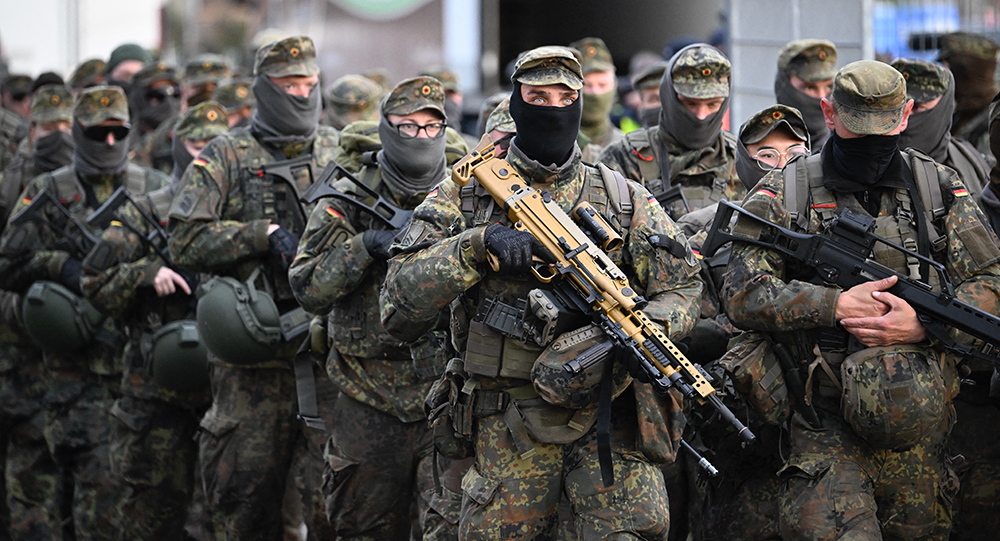
What would happen if Russia was planning an attack on Estonia, Lithuania or Latvia – and the threat was sufficiently great that Nato felt the need to send troops east across Europe to face off against Moscow?
This was the scenario the German Bundeswehr spent several days rehearsing last month, working out how the army would transport its soldiers towards Nato’s eastern flank in the event of conflict in the Baltics. For three days, the port city of Hamburg played host to the exercise Red Storm Bravo: 500 soldiers, along with roughly 300 members of the emergency services and other civilian organisations, took part – the largest military exercise in the city since the end of the Cold War.
In the event of conflict with Russia, Germany would, because of its geographical position, become a ‘hub’ for Nato to coordinate the flow of soldiers and weaponry to the front line in the east. Troops from the US and across western and southern Europe – including Britain – would flow through the country towards Warsaw and on. The purpose would be deterrence in the hope that a show of international force would put Vladimir Putin off an attack that would test Nato’s commitment to Article 5, which considers an attack on one member to be an attack on all.
It would be a huge operation: the Bundeswehr’s Operation Plan Germany, details of which were leaked to the press last year, envisages 800,000 Nato troops and 200,000 vehicles travelling across the country towards the front line. According to one army source, even with Germany’s motorways and ports used to full capacity, this would take close to a week. Red Storm Bravo was a rehearsal of the section of Operation Plan Germany that runs through Hamburg.
The purpose of Red Storm Bravo was as much to familiarise German civilians as the army with what to do in the event of a coming war. Only a fraction of the Operation Plan Germany soldiers were used but the scenarios neatly reflected the possible challenges. Soldiers rehearsed setting up and manning checkpoints; the fire service practised fishing a sinking barge out of Hamburg’s port; and the ambulance service simulated a mass casualty event with multiple victims.
The first day’s main event was moving a military convoy through the centre of the city after dark. As the sun set over Hamburg’s port, I watched the heavily armed soldiers march towards a fleet of about 70 military vehicles, lined up three abreast. Some were small armoured vehicles, others enormous Rheinmetall-branded trucks, several with machine-gun turrets that would later be manned as the convoy sped through the city. Many soldiers wore balaclavas to prevent them being identified, according to our Bundeswehr escort.
There is an art to travelling in a convoy. It moves as one, meaning that as long as the leading vehicle continues to move, the others follow suit in an unbroken line, regardless of red traffic lights or civilian traffic. This convoy of just 70-odd vehicles snaked back roughly 2.5 miles – a considerable logistical challenge.
At two points along the route, the convoy was stopped by pretend protests: at the first, army reservists in civvies waved banners and chanted at the convoy to ‘turn back’; at the second, ‘protestors’ staged a sit-in, with signs saying ‘glue’ around the necks of some to denote those who would have stuck themselves to the ground. The point was for the riot police to practise removing them. Groups of three took turns: a grab at the protestor’s head from behind and a knee to the back, one arm twisted around, then the other, allowing the police to peel them off the ground and carry them away.
When the planning for Red Storm Bravo was initiated, few could have predicted the new significance it would take on in the weeks leading up to it. Last month, a series of suspected Russian drone incursions into Nato territory set alarm bells ringing. Alongside Germany, Romania, Denmark, Norway and Poland have all reported drone activity close to military bases and other critical infrastructure. Meanwhile, three Russian MiG-31 fighter jets entered Estonian airspace for a total of 12 minutes on 19 September.
‘We developed the scenario for Red Storm Bravo last December and now reality has actually caught up with us somewhat,’ said Captain Kurt Leonards, the head of the Bundeswehr’s Hamburg command who oversaw the exercise. ‘Whether that’s in Poland, in Estonian airspace, or even the whole discussion now taking place in Denmark, it shows how topical this issue is, and that’s why we have to react very quickly and expand our capabilities.’
Poland and Estonia triggered Nato’s Article 4 less than two weeks apart, requesting alliance members come together to discuss the incursions. While the mood in Nato’s Brussels HQ appears to be calm so far, the rhetoric coming from individual members is somewhat more bellicose.
In comments supported by Nato chief Mark Rutte, Donald Trump gave his endorsement to any Nato ally shooting down Russian aircraft entering its territory. Poland and Lithuania have declared they will do precisely this. German Chancellor Friedrich Merz said: ‘We are not at war, but we are no longer living in peace either.’ The German government intends to change the law this autumn to allow the army to shoot down any drones deemed a threat. Last month the EU agreed to move forward with building a technological ‘drone wall’ along its eastern boundary.
The mood on the ground in Germany is clearly jumpy, too. At approximately 1 a.m. on a stretch of road just outside the centre of Hamburg, as the Red Storm Bravo convoy paused to set up for the second of its two protest simulations, a whining buzz became audible overhead. Alarm bounced around the crowd of assembled press and official observers as a small black drone hovered above us. ‘Is it one of ours?’ someone asked nervously. It was only after a press photographer was able to get a grainy shot of it that one of our military escorts confirmed it did indeed belong to the Bundeswehr.
Leonards confirmed that Hamburg had seen an increase in drone activity. ‘Of course, you don’t always know where the drones are coming from,’ he said. ‘Are these drones the work of a state actor that’s systematically operating here? Or do we have a teenager with a remote-controlled drone who wants to test how fast the police can arrive on the scene?’
Following years of under-investment, the German army is restocking its arsenal thanks to reforms that will see defence spending exempt from the country’s rigid debt rules and a one-off €100 billion fund ringfenced by Merz’s predecessor, Olaf Scholz. Some of this will be invested in anti-drone technology.
In an army barracks in the Hamburg suburbs, the Bundeswehr demonstrated some of the gadgets already available. First to be sent up was a type of ‘hunter drone’ capable of ensnaring other drones mid-flight by shooting out a web, Spider-Man-style. Disabling drones this way avoids having to use expensive weaponry to shoot them down and lowers the risk of falling debris injuring civilians. Once the hunter drone had lowered its catch to the ground, a four-legged ‘drone dog’ dubbed ‘Lassie’, equipped with a camera and other sensors, was sent out to inspect it.
Nevertheless, questions over the German army’s readiness for conflict remain. In June, defence chief General Carsten Breuer warned that Russia could be ready to launch an attack on a Nato state by 2029; according to one government source I spoke to, this could be even sooner. Meanwhile, according to official figures, just under 183,000 soldiers are actively serving in the Bundeswehr, and a damning report published in May revealed that, at the end of last year, more than 20 per cent of military positions remained vacant. The reintroduction of conscription seems inevitable to meet its commitment to Nato troop numbers.
So, is Germany prepared for the defensive challenges ahead? When asked this, Leonards said: ‘Germany is in the process of significantly developing its armed forces and the Bundeswehr. And I believe we’re really on the right track.’ Not a resounding yes, then. But any preparation against an increasingly provocative Russia is better than none.


