sexta-feira, 10 de abril de 2026

The Spectator - Driving isn’t fun any more

 (personal underlines)


Driving isn’t fun any more

Robotic cars are the final insult
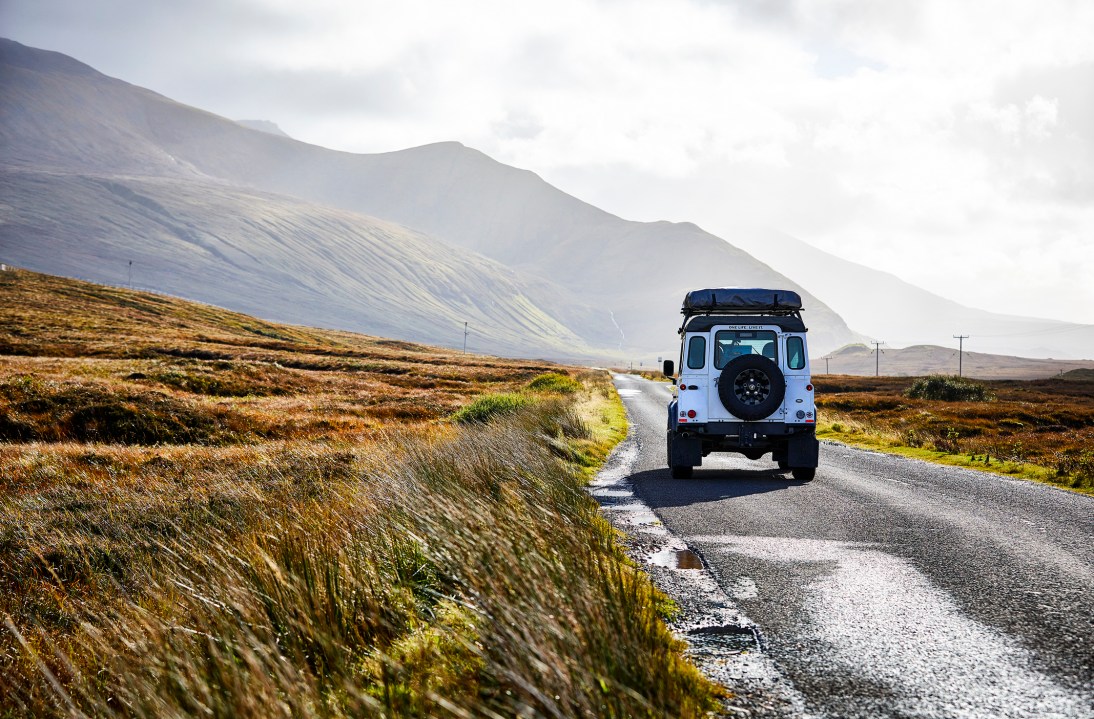
It is almost inconceivable that we used to live in a world where people would ‘go for a drive’. Not to get to a destination, but simply for the pleasure of driving. Sunday afternoons were the time of choice for this activity and would see car owners take to the road simply because it was good fun to be behind the wheel. The idea that driving was anything other than functional now seems absurd.  

That world has vanished, partly due to the sheer volume of cars. In 1971 (the year my dad learned to drive), there were roughly 15 million cars on UK roads. Today, on those same roads, there are 34 million. Driving was more pleasurable when there was space to breathe — empty ribbons of tarmac where you might encounter another car every five minutes. Now, the ‘drive’ is spent in a metal conga line, with journeys that should take 15 minutes routinely taking 50.  

Motorway driving may be the worst sub-category of driving. These days, the M25 is more a car park than a road, where one can enjoy the experience of watching their fuel gauge descend simultaneously with their will to live. If you’re lucky enough to actually move, you’ll be tailgated by a BMW, cut up by an HGV, and then get stuck behind a Nissan Micra (not overtaking) in the middle lane.  

There is also the matter of modern technology. Modern cars come equipped with LED headlights so bright they could double as anti-piracy searchlights. Using your rear-view mirror requires similar precautions to be taken as viewing a solar eclipse. Fail to take these precautions, and you’re subjected to retinal warfare that’s comparable to staring into the detonation of an atomic bomb, leaving you forced to navigate the roads by braille. These lights may well help their users see better, but this is at the expense of temporarily blinding everyone else. We’re led to believe that this is automotive progress. 

What’s most peculiar is what cars do to their occupants. The moment some people’s posterior makes contact with a driver’s seat, they undergo a Jekyll and Hyde-style psychological transformation that is actually just as fascinating as it is horrifying. These are ordinary people — the type that would apologise for being bumped into — who become snarling, hostile beasts the moment they’re encased in metal. The car seems to provide a moral soundproofing that renders the normal rules of human interaction null and void, and road rage, the default setting.  

This anonymous aggression is driving’s answer to online comment sections. I can only guess that our windscreens create just enough detachment from reality for people to feel comfortable with unleashing behaviour that would be unthinkable in a face-to-face interaction. The problem is, road warriors pilot actual weapons. In the hands of someone in the tight grip of automotive sociopathy, a two-tonne Audi Q7 is considerably more dangerous than an angry tweet.  

It doesn’t take long to need a break from driving, forcing road users to descend into what must be the most depressing place on earth and the seventh circle of driving hell: the motorway service station. I stopped at Leigh Delamere Services recently and, on entry, was nearly rendered unconscious by the stench of the lavatories from a good 60 feet. After a wait that was similar in duration to the construction of Cologne Cathedral, I was rudely served a weak coffee and a sandwich that tasted like it had been assembled from materials found down the back of a radiator. For the privilege, I was charged £10. The irony is exquisite, however. The place that was created to provide welcome refuge from the unpleasantness of motorways has become far more unpleasant than the motorway itself. I’d just keep driving if I were you

And if the current state of things isn’t miserable enough, we can expect the arrival of driverless cars by the end of the year, which will presumably deliver the final blow. Any remaining vestiges of motoring pleasure, dead. Technophiles don’t shut up about how these vehicles will be safer, more efficient, more rational. They will — in other words — remove our autonomy entirely from the equation and take us one step closer to rendering humans completely useless. There will be no more spontaneous decisions to take the scenic route, no more stumbling upon a charming village that you didn’t know existed. Instead, we’ll be passengers in our own cars, transported along predetermined routes by robots that can only ever prioritise efficiency. We’ll be no more than delivered to our destination — like a parcel. The ‘Sunday drive’ will be replaced by the ‘Sunday algorithmic transportation experience’. Even worse, these ‘robo-taxis’ will presumably observe speed limits religiously, making them absolutely insufferable to share the road with. 

I don’t expect we’ll see a return of driving for pleasure. There are too many of us out on the roads, and we’re all too unpleasant to each other. But if we could occupy the roads with a touch more courtesy and dim our lights to something short of nuclear intensity, we might salvage some enjoyment from what has become a modern misery. 

Livros - A Revolução Trump


sábado, 4 de abril de 2026

Youtube - Despolariza com Miguel Morgado

 Continua a ser o maior pensador contemporâneo.


https://www.youtube.com/watch?v=6ccQUSOmryI


#108 MIGUEL MORGADO - Conservadorismo, Política, TROIKA, Pedro Passos Coelho, Religião, Austeridade

YouTube - Matemática


Recordar a Matemática  


https://www.youtube.com/watch?v=ZEvUDcr8LDw

Youtube - Douglas Murray: "Something BIG Is About To Happen To Europe.."


Two main features: understand English and be intelligent!...


https://www.youtube.com/watch?v=6Je2HN1nlFk

Música - Roger Glover And Guests - Love Is All


 https://www.youtube.com/watch?v=BR6pYICqZT0

The Spectator - The doctor who wanted me dead

 (personal underlines, silent reflections...)


The doctor who wanted me dead

I know I want to be resuscitated

(Getty)

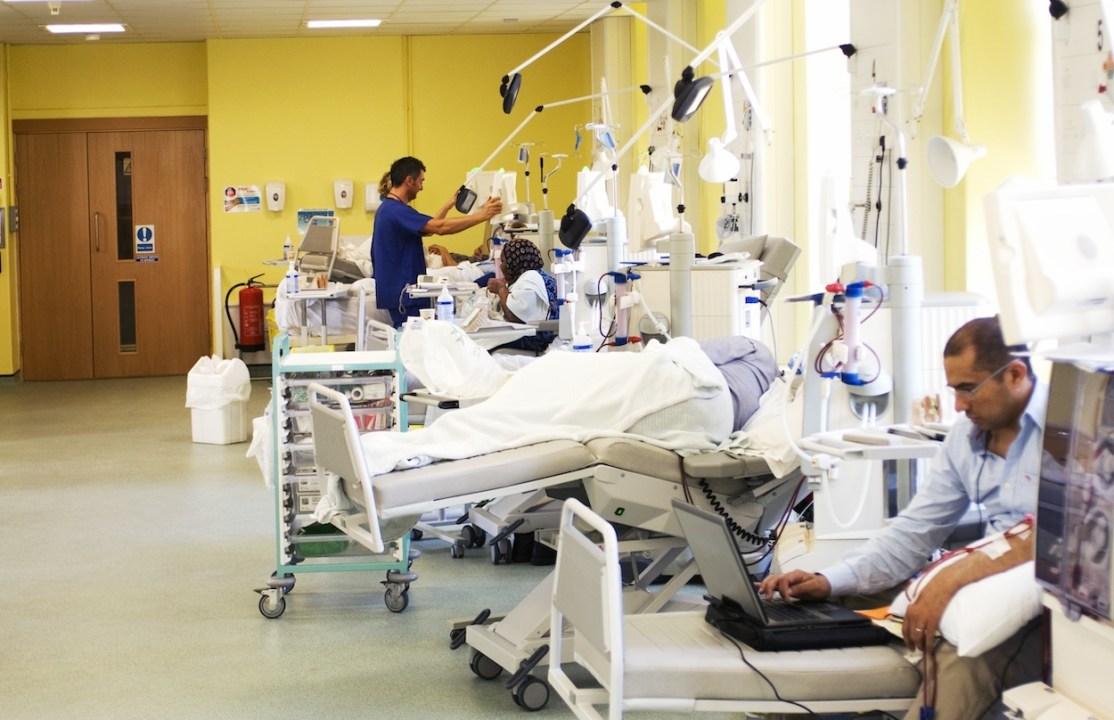
On New Year’s Eve, at about 3 p.m., I phoned for an ambulance. The pressure sore on the weight-bearing surface of my right amputation stump – one of three on that stump – had torn open, exposing bone: specifically, the cut end of the fibula.

Although it was a pain to have to go into A&E, it wasn’t unusual. I had last been discharged from hospital a week before in Glasgow for infection of said pressure sore. The first two of my armoury of autoimmune illnesses – scleroderma, antiphospholipid syndrome, hypothyroidism, autoimmune uveitis and Sjögren’s syndrome – have caused me to have hundreds of hospital admissions over the past 26 years, and around 45 to 50 operations in theatre.

The first assessor on 111 briskly ran through the questionnaire – this would subsequently be repeated three times by other assessors. I told her the pressure sore was on the weight-bearing surface of my right stump, and explained that I was a double below-knee amputee. ‘Any change in colour of your lower leg, ankle, foot, or toes?’ she rattled off from the script. I stopped myself from saying, ‘It’s incredible – since both amputations, my lower legs have been completely transparent.

This was the usual bizarre dance with 111. As I wasn’t having difficulty breathing or hosing out blood, I was phoned back by a ‘medical supervisor’. She didn’t sound hugely experienced, but that isn’t necessarily a problem – I’ve seen young doctors who have been exemplary. After several phone calls from 111, paramedics were despatched. They were, as ever, cheerful, competent and kind. Because it was New Year’s Eve, I couldn’t be taken to St Mary’s, where my excellent surgeon Mr Wordsworth (yes, a relative) works. All the central hospitals were reserved for revellers, and I would be taken elsewhere.

Everyone I saw on that night was lovely, including a female consultant. But the next morning I was visited by a different female consultant. She told me that as well as the osteomyelitis – bone infection – I also had aspiration pneumonia, a form of infection where stomach contents enter your lungs. I had known that: I told the overnight consultant I had coughed strangely two nights previously, so I had asked for the chest XR.

I have had aspiration pneumonia many times, so I recognise the symptoms. Usually it affects the right lung, specifically the right lower lobe, because the right main bronchus is, in most humans, more vertical and wider than the left. When I was in the high-dependency unit in Glasgow (superlative staff), both lungs became infected because I was heavily sedated and didn’t sit up promptly to stop the surge from the stomach.

This consultant was immensely patronising. I asked her which lung had been affected, in case both had been, like last time. ‘Aspiration affects the right lung,’ she said primly, pedagogically. ‘I know!’ I laughed. ‘I was a consultant anaesthetist.’ I kicked myself metaphorically (no feet) for asking a question I knew the answer to just to make conversation.

She ignored my comment and crouched by my bedside. In a lowered voice, she said, ‘There is an important question we ask every patient on admission.’ She went on for a bit without revealing the question, so I smiled and said, ‘Yes, I’ve already been asked. I’m for resuscitation.’

But the consultant remained where she was, and continued as if I hadn’t spoken. ‘In my opinion, you should not be for CPR,’ she said, as my jaw muscles slackened. ‘CPR only has a 20 per cent chance of success. Even in those cases where it is successful, quality of life afterwards is very poor. I think that if you had a cardiac arrest, it would not be in your interests to resuscitate you. The quality of your life now is very bad, and if they succeeded in resuscitating you, it would be even worse.’

‘But I really enjoy my life,’ I said, finding myself pleading for it. ‘I’m still productive. I write for The Spectator, and…’ Unhearing, unrelenting, she continued in a steely voice. ‘It’s something to think about. I have given you my opinion. You are weak, you have heart problems. Your quality of life is poor and would be worse if you were resuscitated from a cardiac arrest.’ 

‘It would be worse if I wasn’t resuscitated,’ I muttered. What a contrast with my regular consultants, who are positive and actively trying to better the lives of their patients. The Angel of Death wanted to curtail it. I’m still on that ward, being looked after by excellent, kind, compassionate nurses and, thankfully, different doctors. Apart from the noise, night and day, it has been fine. I don’t just rage, rage against the dying of the light, but also against clinicians who think they’re God and that a disabled person at 61 has lived long enough.

The Spectator - I’ll take a country walk over the gym any day

(personal underlines) 


I’ll take a country walk over the gym any day

I know by now that I'll never stick to my new year’s resultions

(iStock)

Despite having eaten my own body weight in chocolate over Christmas – and vowing to do better in the new year – my inner Augustus Gloop means I still feel duty-bound to finish what’s left. Self-control when it comes to eating has never been one of my strengths. My New Year’s resolution about a healthier diet will have to wait. In addition to buying the usual tubs of festive favourites – Heroes, Quality Street and Roses – I got a ton of confectionery as Christmas presents. I reason that it would be ungrateful not to enjoy it.

My New Year’s goals are perennial: eat less and exercise more. I fail every time. I mean, I do a reasonable amount of exercise anyway: at least 10,000 steps a day with the dog, yoga every evening and a martial arts class once a week. But I really need to do more cardio. I bought a pair of running shoes last year with the intention of joining the local parkrun, but never quite made it: 9 a.m. on a Saturday seemed just that bit too early. I did road-test the new joggers a few times, but swiftly lost interest. So dragging my 58-year-old carcass along to the park is back on my to-do list.

January is notoriously the time when gym membership peaks. I’ve belonged to several over the years and, typically, after the initial burst of enthusiasm, my attendance has tailed off dramatically. Quite apart from feeling slightly intimidated by the serious bodybuilders, I find the hot, sweaty, artificially lit environment unconducive. I’d much rather be outside in the fresh air. I also find it boring. Running on a treadmill – never reaching a destination – like a hamster spinning on its wheel in time to techno music – feels like an exercise in futility. A country walk listening to a radio play on my AirPods is far more appealing.

Dry January doesn’t really affect me, as I tend not to drink at home anyway unless we have guests. But Christmas was a bit of a washout: our youngest spent three days in hospital after an extreme allergic reaction caused her to blow up like a pufferfish. As a result, my opportunities for tippling were scant. So I feel that I’m owed a couple of trips to the pub this month. Besides, January’s not the best time to go alcohol-free: it’s cold, dark and nobody has any money.

Veganuary has never appealed. While on holiday in Sri Lanka once, my then girlfriend and I were invited to dinner by some vegans. It was one of the strangest experiences of my life. The evening didn’t get off to a great start after they revealed they were from Dresden and then looked at us with narrowed eyes as if expecting an apology (thanks, Bomber Harris!). We were offered a mixture of berries, fruits and nuts, which, while undeniably healthy, didn’t make for a particularly satisfying meal. Maybe they grazed all day like herbivores. When we asked for water, the head vegan smirked and said they got all the liquid they needed from the food they ate. Apart from being decidedly odd, what was most off-putting was their appearance: emaciated and listless, with a strange, faraway look in their eyes as if they were party to some cosmic truth the rest of us didn’t share. A positive advertisement for veganism, they were not. After making our excuses, we returned to the hotel and – still being in time for the evening meal – sat down at the all-you-can-eat buffet. I’ve rarely eaten with greater relish.

Reading more is always high on my self-improvement list at the start of any year. Being something of a bibliophile, I’ve accumulated a half-decent collection of books. However, I’m now beginning to worry I might not live long enough to read them all. I used to keep a pile by my bed, reading from a selection every evening. Now I struggle to manage two. Those Penguin Classics that I’ve never quite got round to – Aristotle, Cicero, Edward Gibbon – have become little more than dust magnets. But I have set myself the task of reading Meditations by Marcus Aurelius this year. I’m still on the introduction.

After Christmas, the wife and I sat down with the cookery books and made a long list of healthy recipes. We also bought ourselves a smoothie maker and have been enjoying effortless fruit-laden drinks. It’s a welcome antidote to the cloying richness of Christmas food. However, the leftover cake is almost begging to be eaten. And I’ve already made two trips to Greggs since the year started.

Irresolute I may be, but I bumble along doing the best I can, self-aware enough to realise that setting myself lofty goals will only lead to even greater failure. Hence the same resolutions each year. At least I know I’ll fail to keep them, which will lessen the disappointment in myself. In Charlie and the Chocolate Factory, Augustus Gloop falls into the Chocolate River, gets sucked up a pipe and emerges much thinner, having been squeezed by the machinery – which, as a weight-loss method, doesn’t seem too bad. I’ll try to walk that bit faster and further, watch the calories and, perhaps, if you’re in my part of Bristol this spring, you may just see a large, middle-aged man bringing up the rear as he huffs and puffs his way to the end of a 5 km run.

The Spectator - The end is drawing near for Iran's mullahs


 (personal underlines)

The end is drawing near for Iran's mullahs

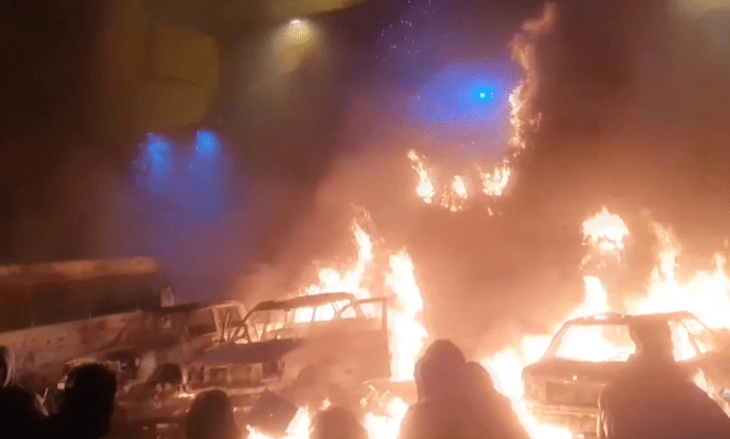
Buildings and cars were set on fire in Tehran (Credit: BBC)

As a wave of protests swept across Iran last night, the internet was completely shut down. I have no idea what is happening to my friends, my family, or anyone else. My best friend Champ was at the demonstration. I desperately hope he is safe.

Overnight, there were protests throughout Iran. From Qom and Mashhad, the most religious cities, to Rasht and Anzali, the most secular, people took to the streets. In Tehran, there were protests in the poorest parts to the richest parts of the city. I couldn’t believe my eyes when I saw the huge crowd in Pol-e-Roomi, a neighbourhood in Tehran where prices are comparable to London.

One reason why so many took to the streets is Crown Prince Reza Pahlavi’s call to action for the first time. When he invited people to protest at 8pm on January 8 and 9, his message received 3.2 million likes and 88 million views – a historic record on Persian Instagram.

Why are the richest and poorest parts of Iran, the most religious and the most secular parts, revolting together? Because this revolution isn’t about the left or right. It is about people wanting to be a nation, rather than an ummah. We want to be citizens, not soldiers of a reactionary Islamist cause. 

Iran is a nation wanting its soul back. Protesters burn the Islamic Republic flag and replace it with Iran’s real flag: the Lion and Sun. It is a nation reclaiming the soul of civility, not Islamic barbarism; patriotism, not IRGC internationalism. This is a national revolution to take back what was stolen from us by Islamists: our history, our culture, our way of life. This is the revolt of Persian culture against political Islam.

I hate to be a victim, and I hate victimhood politics as a Thatcherite, but I can’t stop crying when the Islamic Republic attacks hospitals in Ilam to arrest protesters in their beds, and the human-rights mob do not react. They only seem to worry about hospitals when Hamas stores ammunition in them. Normal Iranian citizens? They can’t be bothered. So far, 36 protesters have been killed in just ten days. Western activists don’t seem to care.

The Iranian protesters’ strategic mistake is that they want to be friends with the West. For this reason, the pro-Palestine mob is silent.

Donald Trump, at least, has spoken up. The US president has said the regime will be hit ‘very hard’ if it acts violently against protesters. As a result, demonstrators are changing the names of streets in Tehran to ‘Trump Street’. The Crown Prince has said he is ready to lead the transition to democracy. People chant: ‘This is the final battle – Pahlavi will return.’ It certainly feels like the end is near. No one can predict the exact date the regime’s leaders will leave my country, but it is obvious that it is a matter of time.

The Islamic Republic has used every tool of repression to prevent people from protesting. Since September 2022, dozens of children have been killed by the regime. Nika Shakarami, a 16-year-old, was tortured, raped, and then killed by the IRGC. Her final moments were spent resisting her attackers.

I wish Shakarami was alive so that she could hear the chants of ‘death to the dictator’ and ‘Akhoond bayad gom beshe’, which means ‘the mullahs should f–k off’. In a new Iran, those like Shakarami could live a normal life: wearing what they want, protesting without the risk of being raped by Islamist terrorists. I wish Shakarami, and all those who gave their lives fighting the terror state of the Islamic Republic, could see this day.


The Spectator - Life is more complex than we like to admit


 (personal underlines)

Life is more complex than we like to admit

Our culture is addicted to absolutes

Sitting on the fence is fine (iStock)

In this strange new world we inhabit, where many people appear to struggle with nuance, the oversimplification of complex problems means that any shades of grey are ignored. This informal logical fallacy, in which every situation is presented as having only two possible options when, in reality, more exist, is now standard in politics and across mainstream and social media. However, rather than being seen as a sign of intellectual weakness, taking entrenched positions is considered perfectly reasonable.

Think 7 October was depraved and insane? You’re Zionist sympathising scum. Appalled by images of children in Gaza made homeless by the conflict, struggling to lift a spoon to their mouth because they’re shaking so violently from the cold? You’re a pathetic Hamas apologist.

Think Brexit hasn’t exactly been a great success? You’re a sad, embittered remoaner. Wonder where all the unaccounted-for billions overseen by unelected EU officials have disappeared to? You’re a Faragist nutjob. And so on.

I’d like to think – although I have no evidence for this – that there is a silent majority who, like me, inhabit the middle ground on most things. Human beings are a mass of contradictions, and I’m no exception. Part liberal, part centre-right, I simultaneously hold contradictory positions on many topics. For example, I don’t believe in the death penalty, for the simple reason that, in my opinion, the average politician shouldn’t be left in charge of a doughnut stand at a car-boot sale, never mind being allowed to legislate back into existence the state’s right to kill people, usually in a macabre fashion. But do I read stories about people I think deserve to be shot? You bet. And if someone had harmed a loved one of mine, I’d want to be the person pulling the trigger.

My position on the introduction of gay marriage was unequivocal – I was entirely in favour. Why would you deny two people of the same sex who love each other the same right as everyone else to solemnise their union, and I’m glad that homosexuality is now hardly worthy of comment. But I take a dim view of encouraging children who are confused about their gender down a path that is potentially harmful to both their minds and their bodies.

Do I believe in uncontrolled immigration? No – it would lead to economic and social catastrophe. Do I think a certain level of immigration is not only necessary, but also desirable? Without doubt. You only have to look at our most successful immigrant communities to see the benefits. You get the idea.

However, many seem unable to cope with cognitive dissonance and instead seek the security of moral absolutes. The inability to deal with ambiguity – whether in themselves or in life generally – is leading to a world in which people hold a completely binary view of everything and are unable, or unwilling, to reach consensus. The consequences are potentially devastating, and we’re already seeing examples of the damage this causes, such as extreme political polarisation leading to violence.

To move beyond this age of false dichotomies, which is causing serious societal harm, we need to reach a point where finding common ground is once again considered the most desirable outcome. To do so, people must relearn how to accept life’s complexities. Life isn’t simply a matter of either-or – right versus wrong – it is, and always has been, more subtle than that. These distinctions should be embraced, not rejected. They add depth and meaning to our existence. Without them, we become myopic, miss the bigger picture, and rob ourselves of a more complete understanding of the world.

Plato sought to overcome false dichotomies through dialectical rhetoric. Rather than accepting mere opinion or belief, he advocated pursuing genuine knowledge through rigorous questioning, dialogue, and logical argument to arrive at episteme – true knowledge. He sought a comprehensive understanding of a subject rather than limiting himself to a single point of view, and he accepted the limits of his own knowledge. Education in private and grammar schools was once heavily classical, with students studying the works of Aristotle, Cicero, Plato, and others. They learned structured argument, moral reasoning, and how to distinguish persuasion from truth. These skills have now all but disappeared. To reverse the emotional manipulation, moral absolutism, and factionalism we see all around us, they desperately need to be taught again as part of every school’s curriculum.

Instead of sleepwalking towards a future in which we are unable to think critically, we must once more embrace life’s complexities to recover depth, meaning, and perspective. Nuance is essential for that journey, guiding us towards a clearer view of the world as it actually is.

quarta-feira, 1 de abril de 2026

Polémia - Vers un coup d’Etat médiatique contre Viktor Orbán, comme en Roumanie ?

 (soulignés personneles)

Bruxelles et les médias subventionnés préparent-ils pour la Hongrie un coup d’Etat démocratique comme en Roumanie au prétexte d’ingérence ? C’est la question que pose Lucas Chancerelle, porte-parole de Polémia, dans le texte ci-dessous.
Polémia

Hongrie : quand le « journalisme d’investigation » devient un instrument d’ingérence

À l’approche des élections hongroises, un phénomène inquiétant se confirme : la dérive d’une partie du journalisme européen vers une logique de guerre informationnelle. Le récent communiqué de l’Observatoire des ingérences démocratiques (OID), initiative du MCC Bruxelles, met des mots sur une réalité de plus en plus difficile à ignorer : sous couvert d’enquêtes, certains médias participent activement à la construction de récits politiques orientés, au mépris des principes fondamentaux de cette profession.

Au cœur de cette controverse, une cible privilégiée : Viktor Orbán. Depuis plusieurs semaines, une avalanche d’accusations spectaculaires s’abat sur le dirigeant hongrois : ingérence directe des services russes dans sa campagne, manipulation des élections, voire scénario extravagant de tentative d’assassinat montée de toutes pièces. Autant d’allégations graves, mais systématiquement fondées sur des “sources anonymes” ou des documents impossibles à vérifier.

La fabrique du soupçon permanent

Ce qui frappe dans cette séquence, ce n’est pas seulement la gravité des accusations, mais leur mode de diffusion. Des médias occidentaux de référence relaient des informations issues de circuits opaques — “sources de renseignement européennes”, “rapports internes”, “contacts sécuritaires” — sans jamais fournir au public les éléments permettant d’en juger la crédibilité.

Le mécanisme est désormais bien rodé : une première “révélation” surgit dans un média spécialisé, souvent lié à des réseaux transnationaux ou financé par des organismes étrangers ; elle est ensuite reprise par de grands titres internationaux ; enfin, des responsables politiques s’en emparent pour lui donner une caution institutionnelle. Ainsi se construit une vérité médiatique, indépendante de toute démonstration factuelle.

Le problème n’est pas l’existence de sources anonymes — parfois nécessaires — mais leur transformation en fondement quasi exclusif du récit. Lorsque des accusations aussi lourdes reposent uniquement sur des témoignages invérifiables, le doute devrait être la règle. Il devient pourtant l’exception.

Du contre-pouvoir à l’arme politique

Le glissement dénoncé par l’OID est majeur : le journalisme d’investigation, censé incarner un contre-pouvoir, tend à se transformer en outil d’intervention politique. En période électorale, cette mutation est particulièrement préoccupante. Car il ne s’agit plus seulement d’informer, mais d’influencer.

En jetant le soupçon sur la régularité du scrutin hongrois, ces récits contribuent à délégitimer par avance ses résultats. Peu importe, au fond, que les accusations soient prouvées ou non : leur simple circulation suffit à fragiliser la confiance dans le processus démocratique.

Ce phénomène s’inscrit dans une dynamique plus large au sein de l’Union européenne, où la question de la “désinformation” est devenue centrale. Mais le paradoxe est saisissant : alors que Bruxelles investit massivement pour lutter contre les manipulations informationnelles, elle reste largement silencieuse face à des pratiques médiatiques qui relèvent elles-mêmes de la désinformation par insinuation.

L’érosion de la confiance médiatique

Les conséquences de cette dérive dépassent largement le cas hongrois. En brouillant la frontière entre enquête et militantisme, ces pratiques alimentent une crise de confiance déjà profonde envers les médias. Le public, confronté à des informations contradictoires et invérifiables, finit par douter de tout — y compris des faits établis.

Cette défiance généralisée est le terreau idéal de toutes les radicalités. En prétendant défendre la démocratie contre des ingérences supposées, certains acteurs médiatiques risquent paradoxalement de contribuer à son affaiblissement réel.

Réhabiliter l’exigence de preuve

Le rappel formulé par l’OID est, à cet égard, salutaire : plus les accusations sont graves, plus le niveau de preuve exigé doit être élevé. Cette règle élémentaire semble aujourd’hui oubliée, au profit d’une logique de l’urgence et du sensationnel.

En période électorale, cette exigence devrait être absolue. Car une information infondée ne se contente pas d’être erronée : elle peut altérer durablement le jeu démocratique. Accuser sans preuve, c’est déjà intervenir.

La question posée est donc simple, mais décisive : le journalisme européen veut-il rester un outil de connaissance ou devenir un instrument d’influence ? De la réponse dépend non seulement la crédibilité des médias, mais aussi la solidité des démocraties qu’ils prétendent servir.

Lucas Chancerelle
29/03/2026

segunda-feira, 30 de março de 2026

Cartoon - Jim Unger


Desporto - Andebol

F.C.P - S.C.P. em andebol

E se este país for mesmo diferente? E se nós formos mesmo mal formados, estúpidos, pobrezitos de mente, atrasados da cuca? 

Sobretudo no desporto!... 

Cá vamos, cantando e rindo...